

|
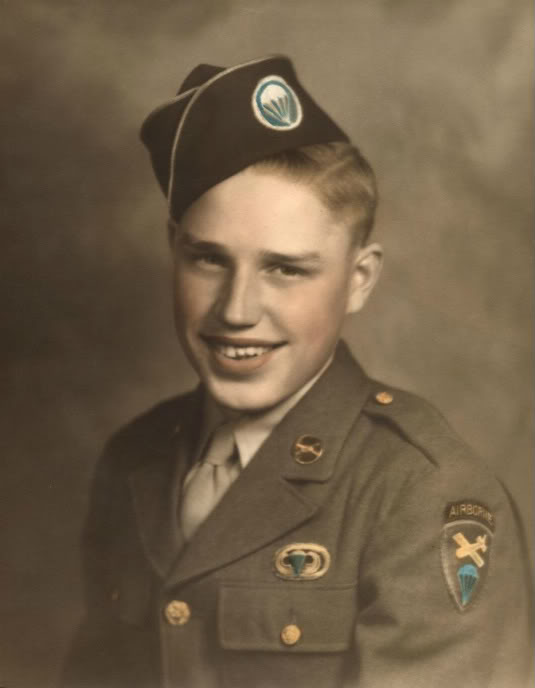
John A. DAUM
"Bud"
| ||||||||||||||||||||||||||||
|---|---|---|---|---|---|---|---|---|---|---|---|---|---|---|---|---|---|---|---|---|---|---|---|---|---|---|---|---|
 | ||||||||||||||||||||||||||||
| NUMBER OF SERVICE | 36816479 | |||||||||||||||||||||||||||
| AGE | 20 yo | |||||||||||||||||||||||||||
| DATE OF BIRTH | 24 April 1924 Marathon County WISCONSIN | |||||||||||||||||||||||||||
| ETAT | Wood County WISCONSIN | |||||||||||||||||||||||||||
| FAMILY | Parents: Paul & Frances DAUM Soeurs: Helen, Marcella & Rosella | |||||||||||||||||||||||||||
| RANK | Private | |||||||||||||||||||||||||||
| FONCTION | Paratroopers | |||||||||||||||||||||||||||
| JOB BEFORE ENLISTEMENT | Farmer at Nasonville WISCONSIN then Worker for "WEINBRENNER SHOE FACTORY" at Marshfield WINCONSIN |  | ||||||||||||||||||||||||||
| DATE of ENLISTEMENT | April 1943 | |||||||||||||||||||||||||||
| COMPANY | Company B | |||||||||||||||||||||||||||
| BATTALION | 1st Battalion | |||||||||||||||||||||||||||
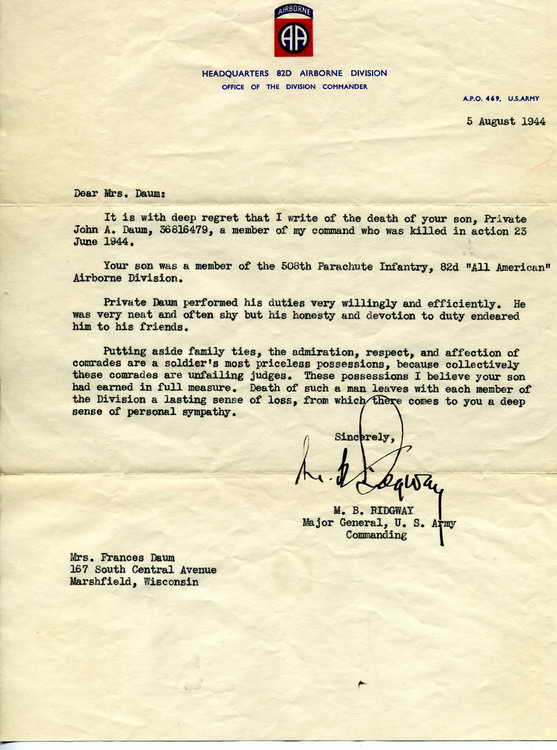
| REGIMENT | 508th Parachute Infantry Regiment  | |||||||||||||||||||||||||||
| DIVISION | 82nd Airborne Division | |||||||||||||||||||||||||||
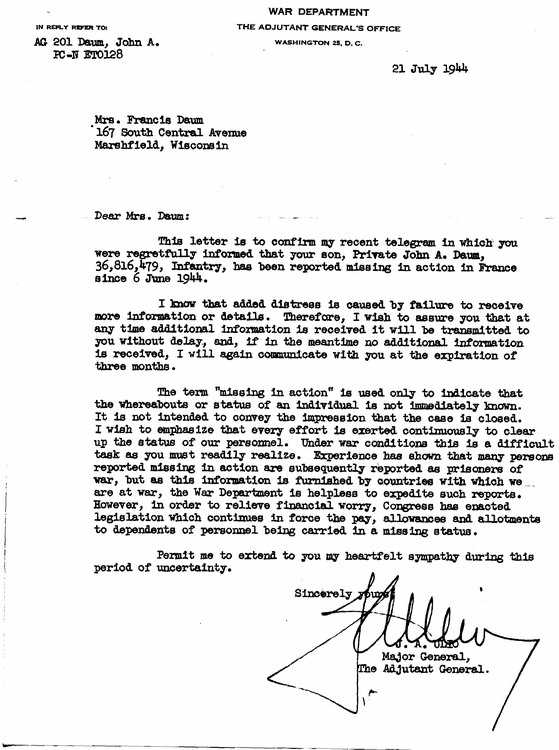
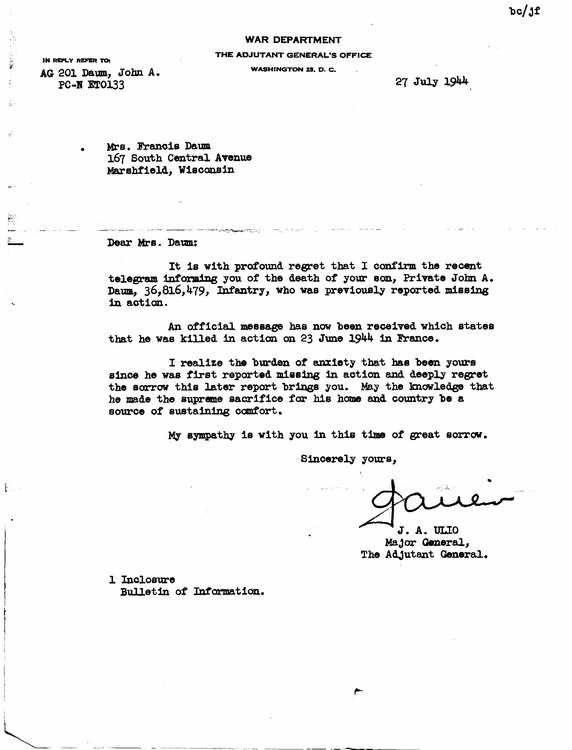
| DATE OF DEATH | 8 June 1944 | 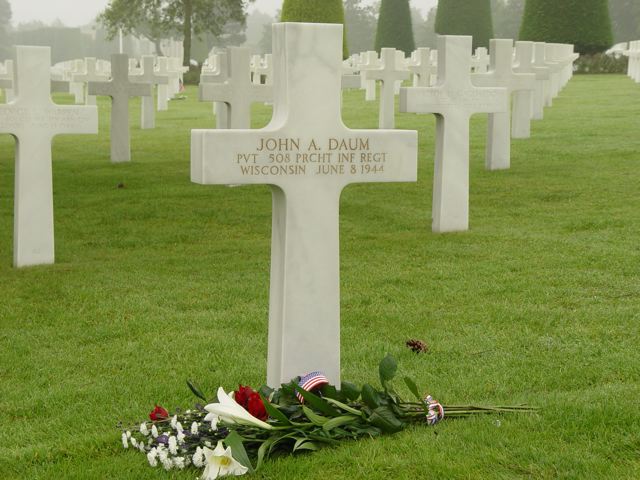 | ||||||||||||||||||||||||||
| STATUS | KIA | |||||||||||||||||||||||||||
| PLACE OF DEATH | Bridge Merderet, La Fière | |||||||||||||||||||||||||||
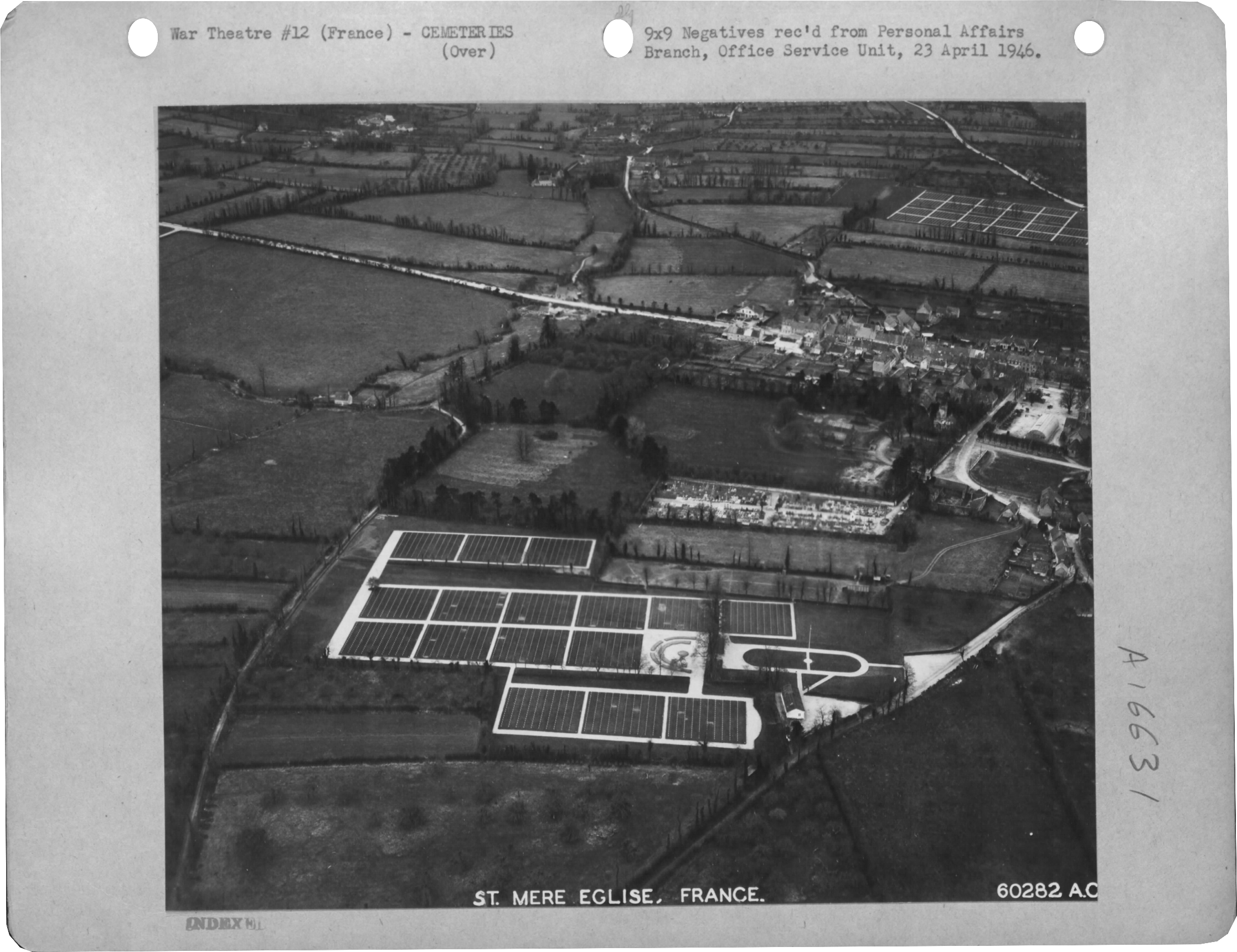
| CEMETERY TEMPORARY |
CEMTERY TEMPORARY of Ste Mère#1 N°3584
| |||||||||||||||||||||||||||
| CEMETERY | NORMANDY AMERICAN CEMETERY of Colleville | |||||||||||||||||||||||||||
| GRAVE |
| |||||||||||||||||||||||||||
| DECORATION |
| |||||||||||||||||||||||||||
| ||||||||||||||||||||||||||||
| STORY | ||||||||||||||||||||||||||||
|
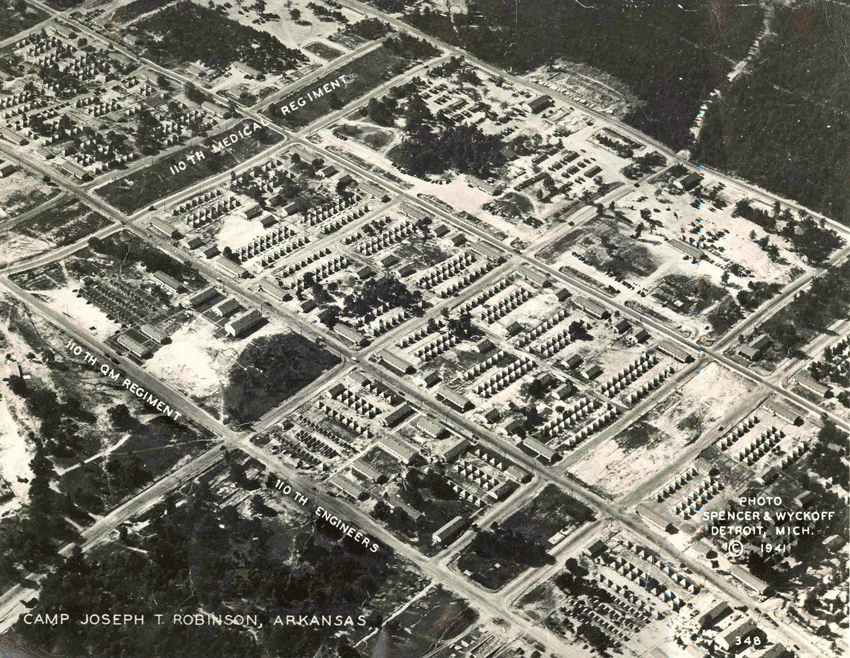
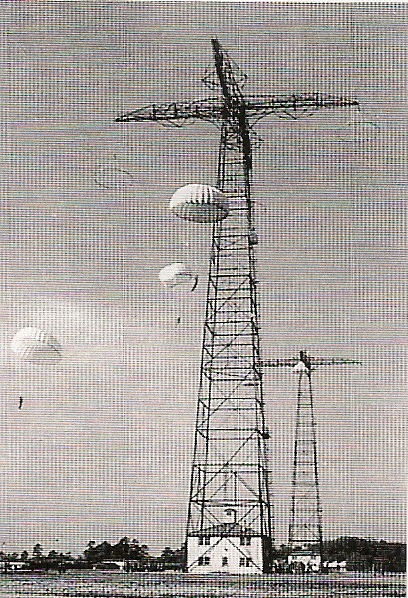
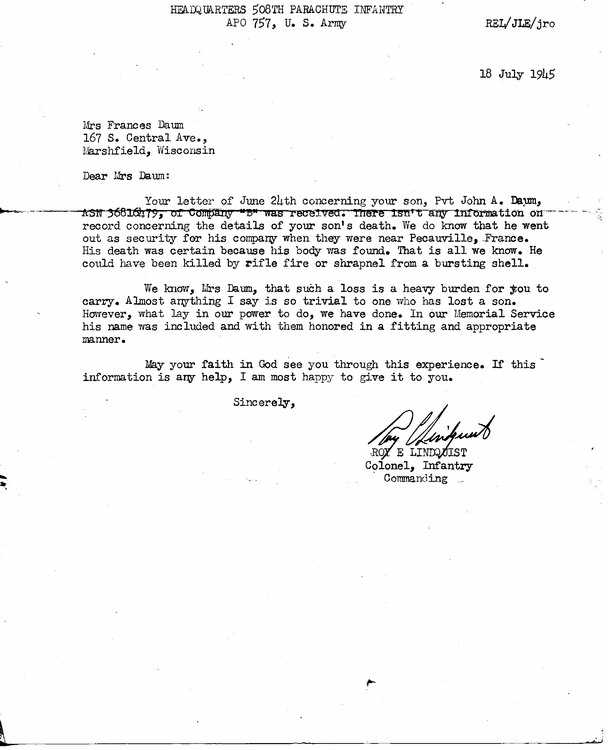
April 1943 basic training Camp Robinson ARKANSAS Assigned to Company D of the 71st Battalion August 1943 FORT BENNING to training assigned to the company H 541 st Parachute Infantry Regiment October 2, 1943 he receives his patent paratrooper Thereafter John was posted to 508ht PIR at Camp Mackall In late 1943 the regiment arrived in Northern Ireland and then joined Nottingham England to receive specific training on D John A DAUM was killed June 8, 1944 when his guard tower camps. John would be killed by a sniper. | ||||||||||||||||||||||||||||
|
"April, 2008"For as long as I can remember my mother always had two pictures of my Uncle “Bud” hanging on the wall. The first was a group picture of Co. D 71st battalion at Camp Robinson, Arkansas. The other was an 8x10 of him in his Paratrooper uniform. For as long as I can remember my mother always had two pictures of my Uncle “Bud” hanging on the wall. The first was a group picture of Co. D 71st battalion at Camp Robinson, Arkansas. The other was an 8x10 of him in his Paratrooper uniform. In 1994, the 50th anniversary, my interest peaked again about my Uncle Bud. I remember seeing the stories about the invasion on the Today Show with the veterans at Normandy. It was at that time I realized what battle my uncle was in and that he may have been killed on D-Day. I remember a fishing trip at the time with my brother Chuck, who served in Vietnam, we talked about the jump and what Bud may have gone through. Little did I know of the things he went through that night. My sister, Virginia, had a friend that had visited the Normandy American Cemetery at this time. She took a picture of his cross and brought back booklets of the Cemetery. Then, when the show Band of Brothers came out in 2001 it really started to make me think about Bud. I really wanted to find out about him. I started thinking. “How do I start? Who and how do I contact somebody?” What compounded the problem is that I did not know my Uncle’s name. All I ever knew him by was Bud. I always assumed, wrongly, that he was named after his father Paul. It was not until my mother took ill in 2006 that I found out my uncle’s name was John A. Daum. I did a search for him on the computer and found out that he was with the 508th PIR of the 82nd Airborne. I have found out a lot about him through the help of Dick O’Donnell and his website "www.508pir.org". With this information I have decided to tell everyone about my Uncle Bud.
| ||||||||||||||||||||||||||||
|
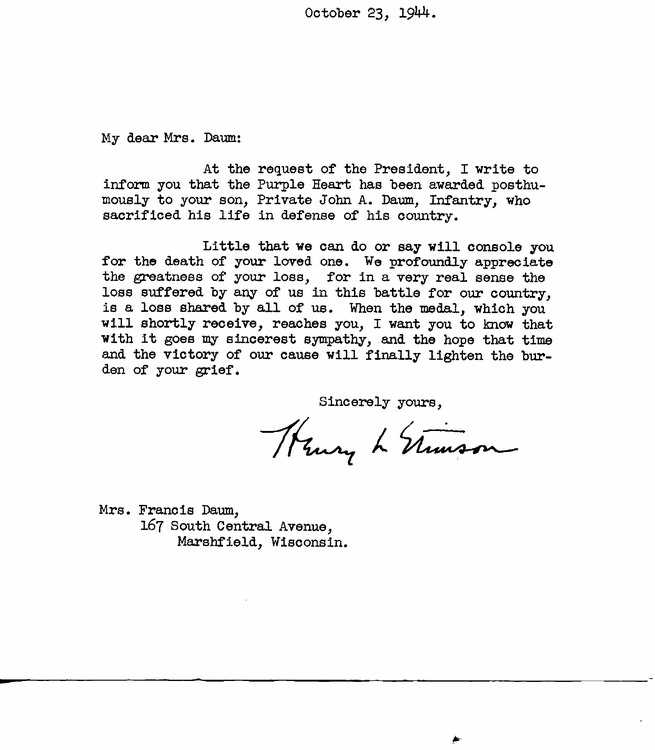
John Daum was born on April 24, 1924 to Paul and Frances Daum in Marathon County, WI. He was the 3rd child of 4. He had 3 sisters Helen, Marcella and Rosella. He received his education at St. Johns Parochial School. He later worked for a farmer near Nasonville, WI. From October 1942 to April 1943 he worked at the Weinbrenner Shoe Factory in Marshfield, WI.
On October 2, 1943 he received his wings. From here he went to Camp Mackall and joined the 508th.
He wrote his Mother and said “the 508th is a good company to be in and that they will be going overseas in three or four months. I am proud to be in the 508th.” Sometime at the end of October he came home for the last time. In returning to camp he recalled of him and a fellow trooper from Illinois having trouble making the train because of a flat tire on the bus, At the end of 1943 John and the rest of the 508th went to Northern Ireland and then to Nottingham England. It was there that Sergeant Walter Barrett had told me of his contact with John. “I knew John personally. I was closely associated with him while we were stationed in Nottingham, England. We trained at this location preparing for D-Day Invasion of France. In letters home from England John said there was not much to do in England but to train and to go into town. He compared Nottingham to Marshfield and mentioned the English girls as being nice. In his last letter home on May 10th he mentioned the training and receiving a package from home. He enjoyed the candy and was wondering if in the next package his mother could send some socks. He also told everyone not to worry and that he hoped to be home in a year. In almost all the letters he sent home he would sign them good luck and love, Bud. In hindsight it was them that should have wished him good luck.
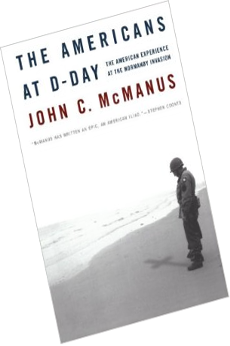
The story goes as follows “Some could not escape the terrifying, depressing feeling that they were witnessing their last sunset. He walked over to him. Daum hardly even replied. He just stood there in a kind of stupor. Boccafogli was really concerned now. “What the hell’s the matter with you?” Daum finally replied in a matter –of-fact tone, “I’m gonna die tomorrow.” Boccafogli tried to cheer him up: “Ahh, come on. Some of us will, some of us won’t, but you ain’t gonna be one.” Daum could not be dissuaded. He insisted on the imminence of his death. Eerily enough, he was right. He got killed on D-Day, Boccafogli never forgot him. “These things stay with you the rest of your life.”
| ||||||||||||||||||||||||||||
|
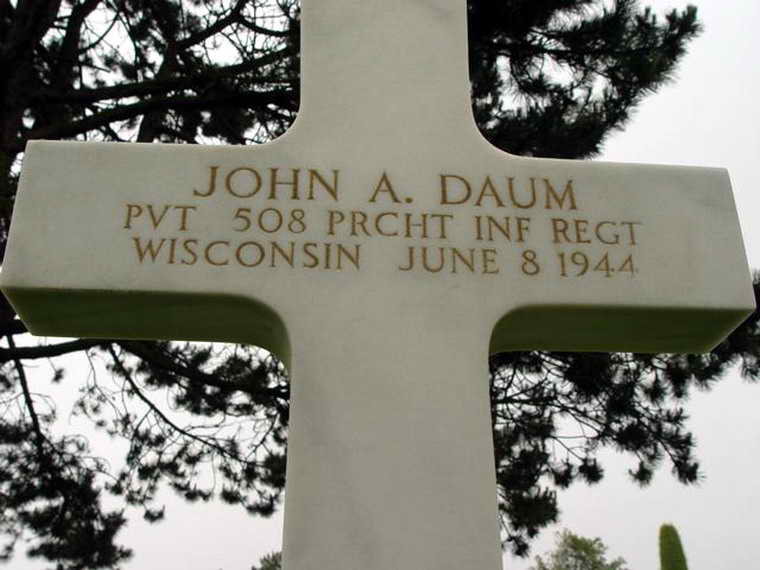
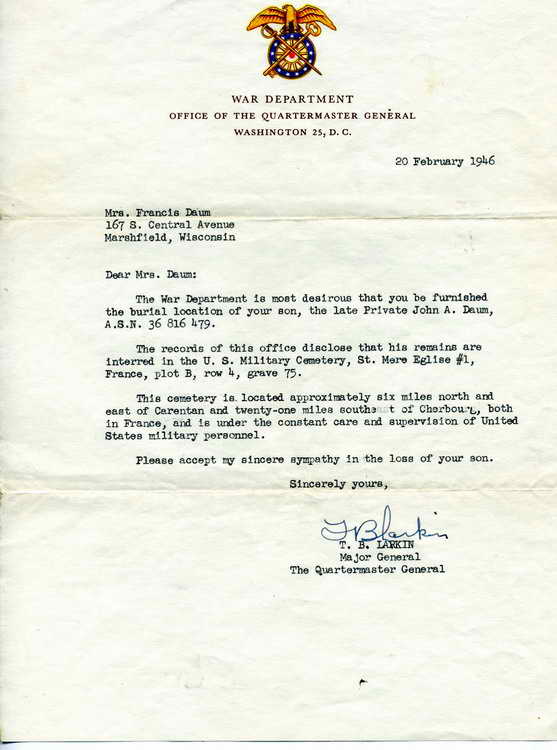
Today John is laid to rest at the Normandy American Cemetery and Memorial in Colleville-sur-Mer, France. His grave is Plot F, Row 23, Grave 42. In a conversation that my niece, Gayle, had with my mother she explained why Bud was never returned to the States. “My mother did not bring him home because a neighbor had brought her son home for burial and it was like losing him all over again and she did not want to go through that again.
| ||||||||||||||||||||||||||||
|
So that is the story of my Uncle Bud at this time. What I have learned was that my uncle was not a very big man, probably about 5’4 and maybe 140 pounds. My mother once told my niece, Gayle, that my uncle “was not very big, was quiet, and enjoyed to smile and laugh.” In the past my mother always told me that her Mother said that “Bud was the flower that never blossomed.” I think today she would not find this to be true at all. As Walter Barrett had emailed me “I am proud to have known him---John A. Daum--- a great American and a brave trooper.” About the only thing left to say is; “Good luck and love.” Written by Thomas Stumpner
| ||||||||||||||||||||||||||||
|
||||||||||||||||||||||||||||







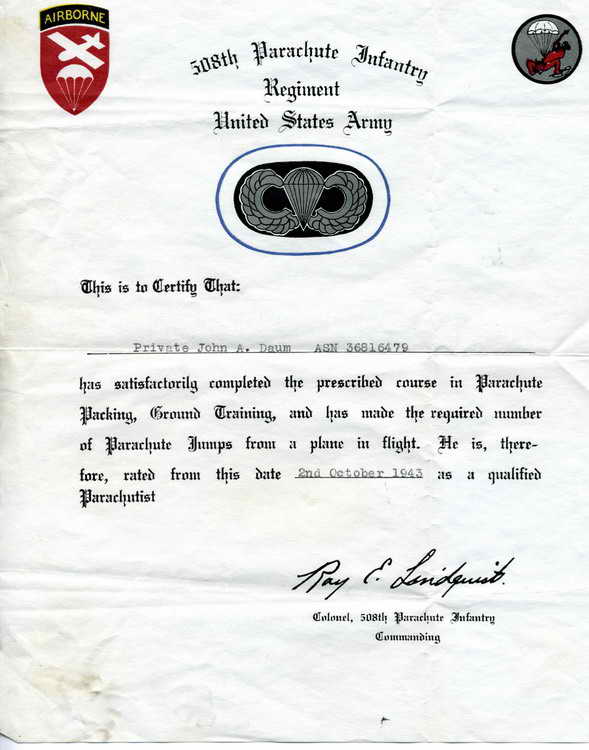 Certificate of Patent Parachute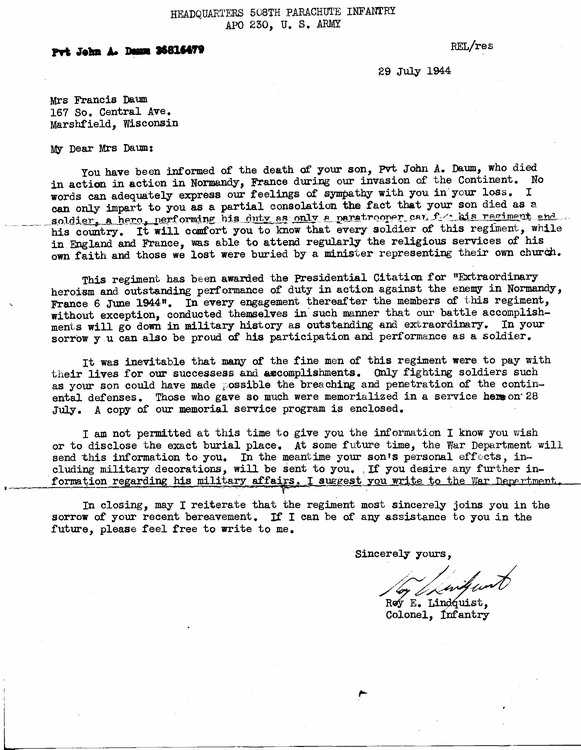
 --
--
 --
--
 --
--

Activated/Activé |
Normandy/Normandie |
| 25 Mar 1942 | Days of Combat/Jour de Combat 422 |
| Casualties/Victimes 9 073 | |
Entered Combat/Entré au combat |
|
| 9 Jul 1943 at Sicily | |
|
Commanding Generals/Commandants généraux Maj. Gen. Omar Bradley (Mar 42 - Jun 42) |
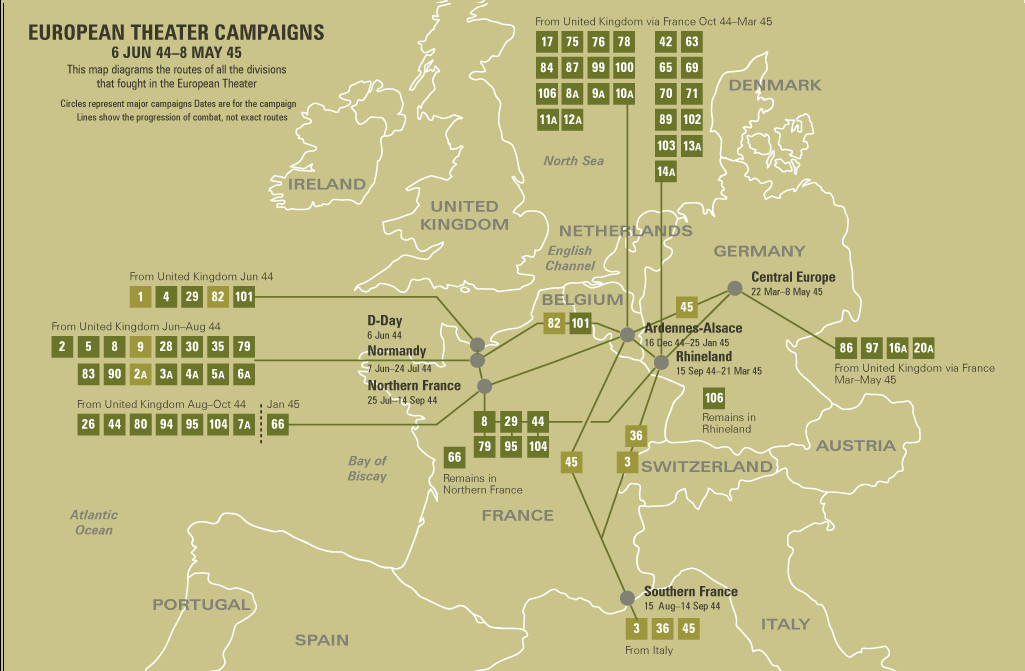
Campaigns/CampagnesSicily (9 Jul - 17 Aug 43) Normandy (6 Jun 44 - 24 Jul 44) Rhineland (15 Sep 44 - 21 Mar 45) |
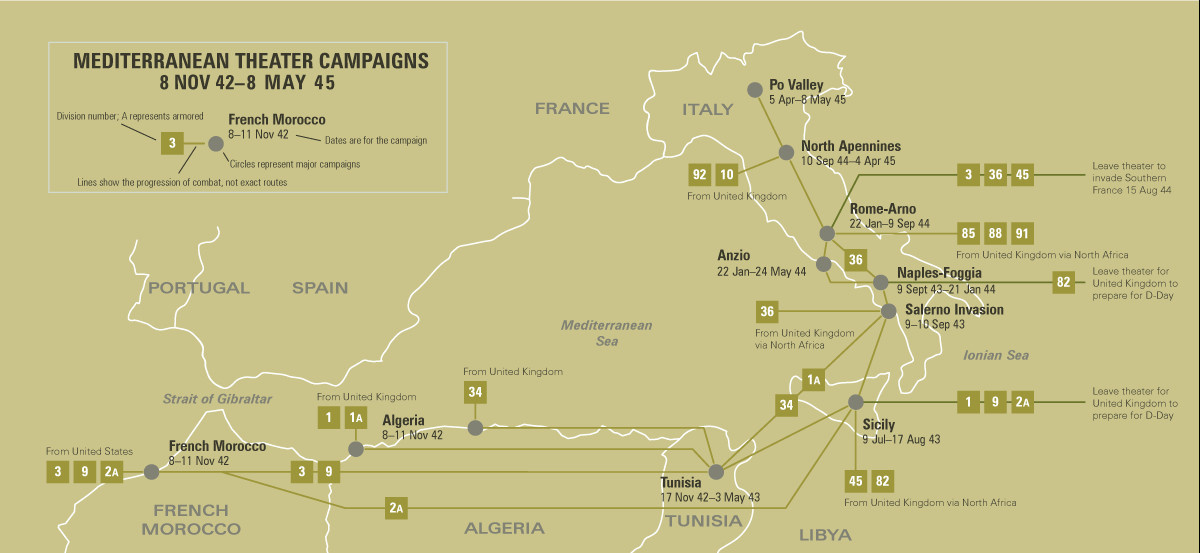
CARTE DE CAMPAGNE DU THÉÂTRE MÉDITERRANÉENCAMPAIGN MAP OF THE MEDITERRANEAN THEATER |
|
 |
|
PLAN DE ROUTE DE LA CAMPAGNE - CAMPAIGN ROUTE MAP |
|
 |
|
DIVISION CHRONICLEThe 82d Airborne Division landed at Casablanca, 10 May 1943, and trained. Elements first saw combat in Sicily, when the 505th RCT and part of the 504th dropped behind enemy lines, 9-10 July 1943, at Gela. The remainder of the 504th RCT dropped, 11-12 July 1943, also near Gela, after running friendly naval and ground force fire. Scattered elements formed and fought as ground troops. The elements were flown back to Tunisia for reequipment and returned to Sicily to take off for drop landings on the Salerno beachhead. The 504th Parachute Infantry dropped, 13 September 1943, and the 505th the following night; the 325th landed by boat. These elements bolstered Salerno defenses and fought their way into Naples, 1 October 1943. After a period of occupation duty (and combat for some elements in the Volturno Valley and Anzio beachhead), the Division moved to Ireland, November 1943, and later to England, February 1944, for additional training. Moving in by glider and parachute, troops of the 82d dropped behind enemy lines in Normandy on D-day, 6 June 1944, before ground troops hit the beaches. Cutting off enemy reinforcements, the Division fought its way from Carentan to St. Sauveur-le-Vicomte, fighting 33 days without relief. Relieved on 8 July, it returned to England for refitting. On 17 September, it was dropped at Nijmegen, 50 miles behind enemy lines, and captured the Nijmegen bridge, 20 September, permitting relief of British paratroops by the British 2d Army. After heavy fighting in Holland, the Division was relieved 11 November and rested in France. It was returned to combat, 18 December 1944, to stem the von Rundstedt offensive, blunting the northern salient of the Bulge. It punched through the Siegfried Line in early February 1945, and crossed the Roer, 17 February. Training with new equipment in March, the Division returned to combat, 4 April, patrolling along the Rhine, securing the Koln area, later moving across the Elbe, 30 April, into the Mecklenburg Plain, where, 2 May 1945, the German 21st Army surrendered. |
CHRONIQUE DE DIVISIONLa 82ème division aéroportée a atterri à Casablanca le 10 mai 1943 et s'est entraînée. Les éléments ont d'abord été combattus en Sicile, lorsque le 505ème RCT et une partie du 504ème ont été largués derrière les lignes ennemies, du 9 au 10 juillet 1943, à Gela. Le reste de la 504ème RCT est tombé, du 11 au 12 juillet 1943, également près de Gela, après des tirs amicaux contre des forces navales et terrestres. Des éléments épars se sont formés et se sont battus en tant que troupes au sol. Les éléments ont été rapatriés en Tunisie pour le rééquipement et sont retournés en Sicile pour décoller pour atterrir sur la tête de pont de Salerne. Le 504th Infantry Parachute Infantry est tombé le 13 septembre 1943 et le 505ème le lendemain soir; la 325ème atterrit en bateau. Ces éléments ont renforcé les défenses de Salerno et se sont introduits à Naples, le 1er octobre 1943. Après une période d'occupation (et de combat pour certains éléments dans la vallée de Volturno et la tête de pont d'Anzio), la division s'est installée en Irlande en novembre 1943 , Février 1944, pour une formation supplémentaire. Se déplaçant en planeur et en parachute, les troupes du 82d tombèrent derrière les lignes ennemies en Normandie le 6 juin 1944, avant que les troupes terrestres ne frappent les plages. En coupant les renforts ennemis, la Division se fraya un chemin de Carentan à Saint-Sauveur-le-Vicomte, combattant 33 jours sans soulagement. Soulagé le 8 juillet, il est retourné en Angleterre pour y être réaménagé. Le 17 septembre, il a été largué à Nimègue, à 50 milles derrière les lignes ennemies, et a capturé le pont de Nimègue, le 20 septembre, permettant ainsi à la 2 e armée britannique de soulager les parachutistes britanniques. Après de violents combats en Hollande, la division est soulagée le 11 novembre et se repose en France. Il fut remis au combat le 18 décembre 1944 pour endiguer l’offensive de von Rundstedt, assourdissant le saillant septentrional des Ardennes. Il a percuté la ligne Siegfried au début de février 1945 et a traversé la Roer le 17 février. S'entraînant avec de nouveaux équipements en mars, la Division est revenue au combat le 4 avril, patrouillant le long du Rhin, sécurisant la région de Koln, traversant ensuite l'Elbe le 30 avril dans la plaine de Mecklenburg où, le 2 mai 1945 s'est rendu. |
| SOURCE INFORMATION & PHOTO | Armydivs.squarespace.com |
|---|
| SOURCE INFORMATION & PHOTO | Usairborne.be - Frédéric LAVERNHE - Coulthart.com |
|---|---|
| PROGRAMMER | Garrett, Clive, Frédéric & Renaud |