


|
Robert Francis FULLOM
| |||||||
|---|---|---|---|---|---|---|---|
|
Source : Historian (Ellen Marchese)
| |||||||
| NUMBER OF SERVICE | 33159721 | ||||||
| AGE | 26 yo | ||||||
| DATE OF BIRTH | 29 January 1918 Corry, Erie County, PENNSYLVANIA | ||||||
| ENLISTMENT STATE | PENNSYLVANIA | ||||||
| FAMILY |
Spouse : Jean Kuhn Son : Eric Parents : Francis & Hildur FULLOM | ||||||
| RANK | Technician Fourth Grade | ||||||
| FONCTION | Paratroopers | ||||||
| JOB BEFORE ENLISTEMENT | Compositor typographer |  | |||||
| DATE of ENLISTEMENT | 25 February 1942 | ||||||
| COMPANY | Company B | ||||||
| BATTALION | 1st Battalion | ||||||
| REGIMENT | 507th Parachute Infantry Regiment | ||||||
| DIVISION | 82nd Airborne Division | ||||||
| DATE OF DEATH | 15 June 1944 |
Source : Brewerlunnen | |||||
| STATUS | KIA | ||||||
| PLACE OF DEATH | La Bonneville | ||||||
| DATA PLAN |
The T/4 Fullom jumped into Normandy on June 6, 1944 from C-47 aircraft [tail# 42-92743] 'chalk' #38, #9 in drop order. Departure from Fulbeck airfield | ||||||
| CEMETERY TEMPORARY |
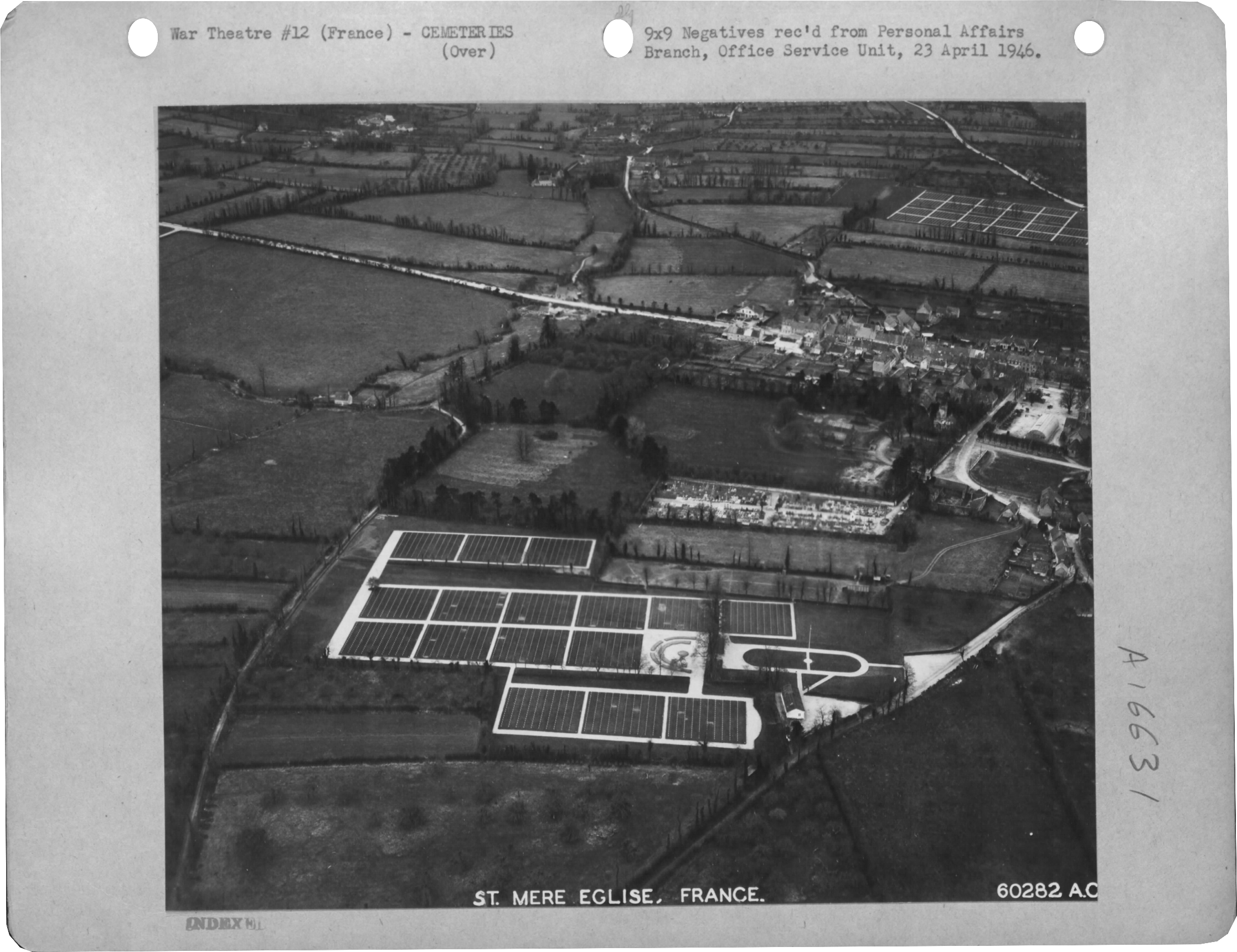
CEMETERY TEMPORARY of St Mère Eglise #1 N°3584
| ||||||
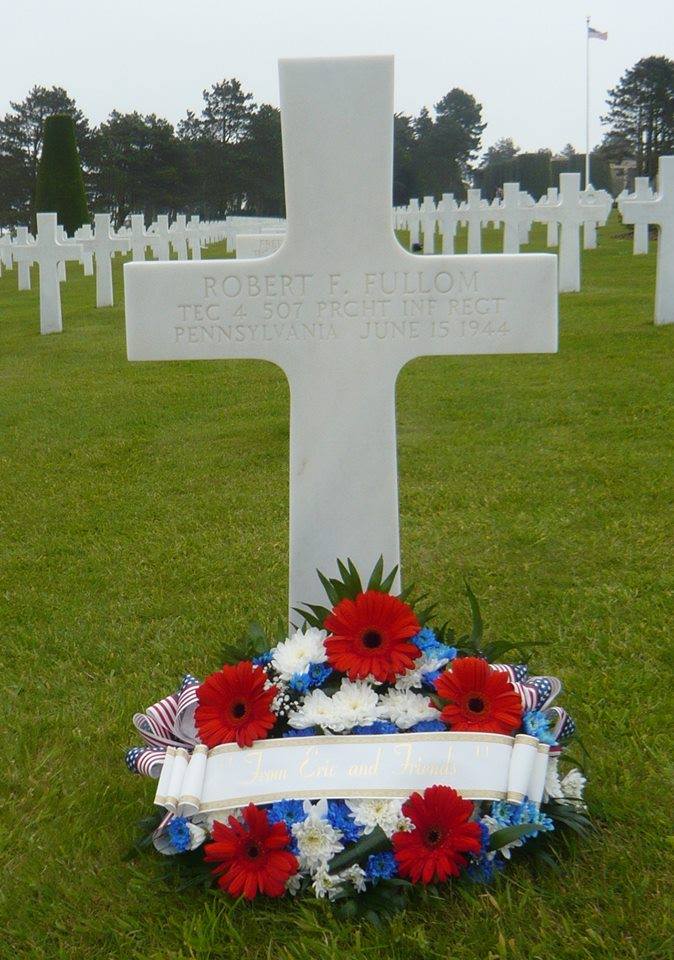
| CEMETERY | NORMANDY AMERICAN CEMETERY of Colleville | ||||||
| GRAVE |
| ||||||
| DECORATION |
| ||||||
| |||||||
| STORY | |||||||
|
Source : Sandra Smith | 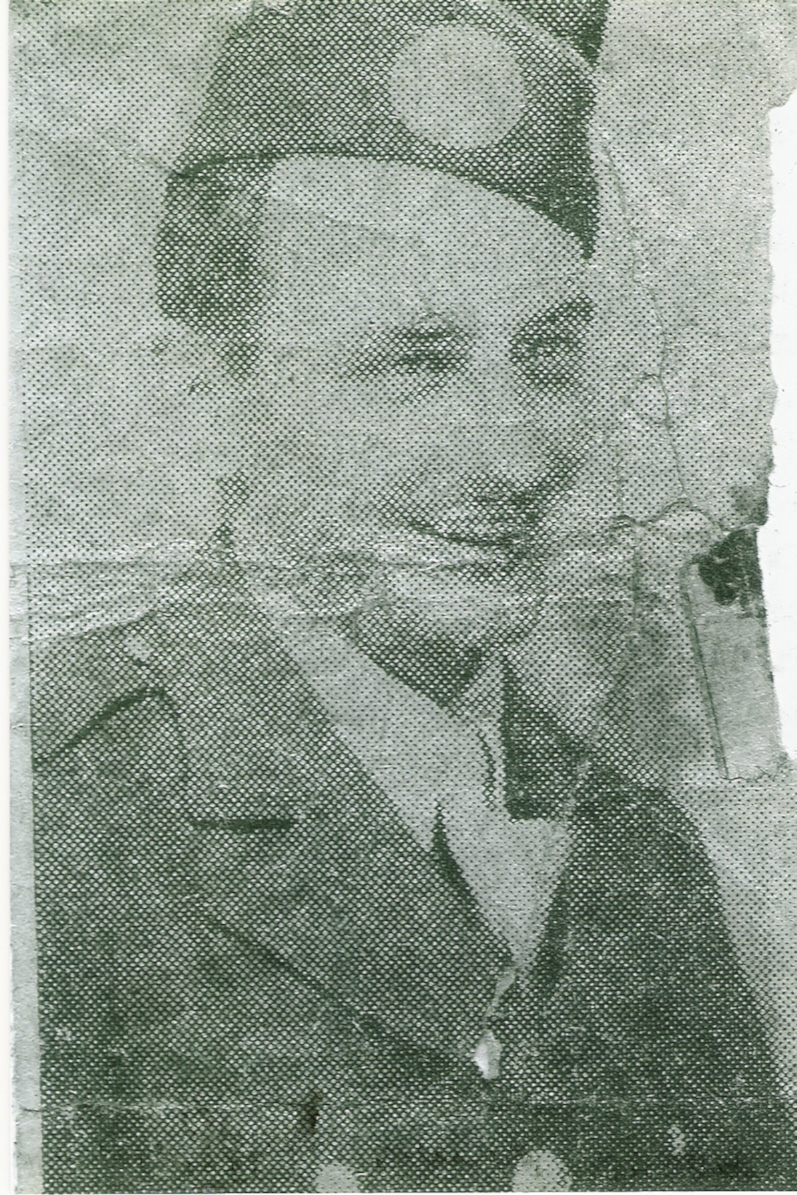 | ||||||
|
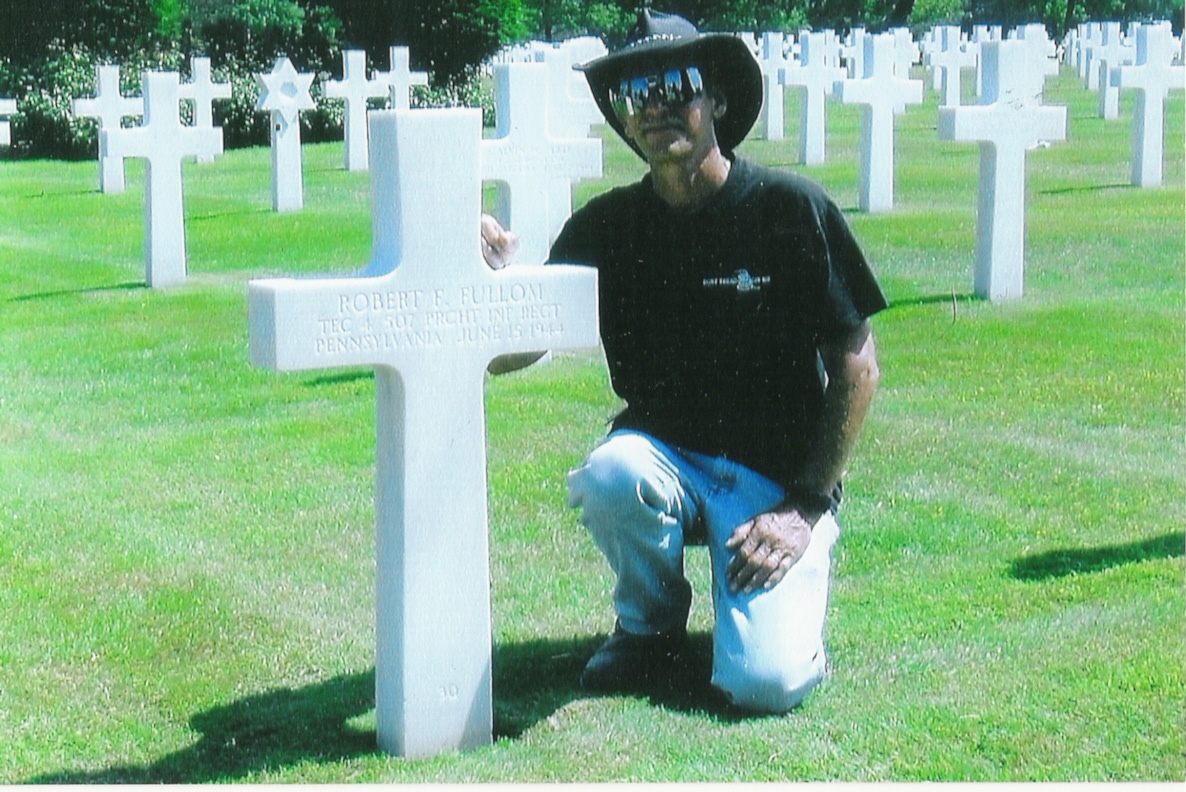
Eric Fullom at his father's grave Source : Sandra Smith | |||||||
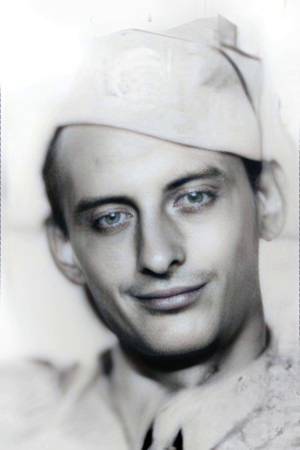





|
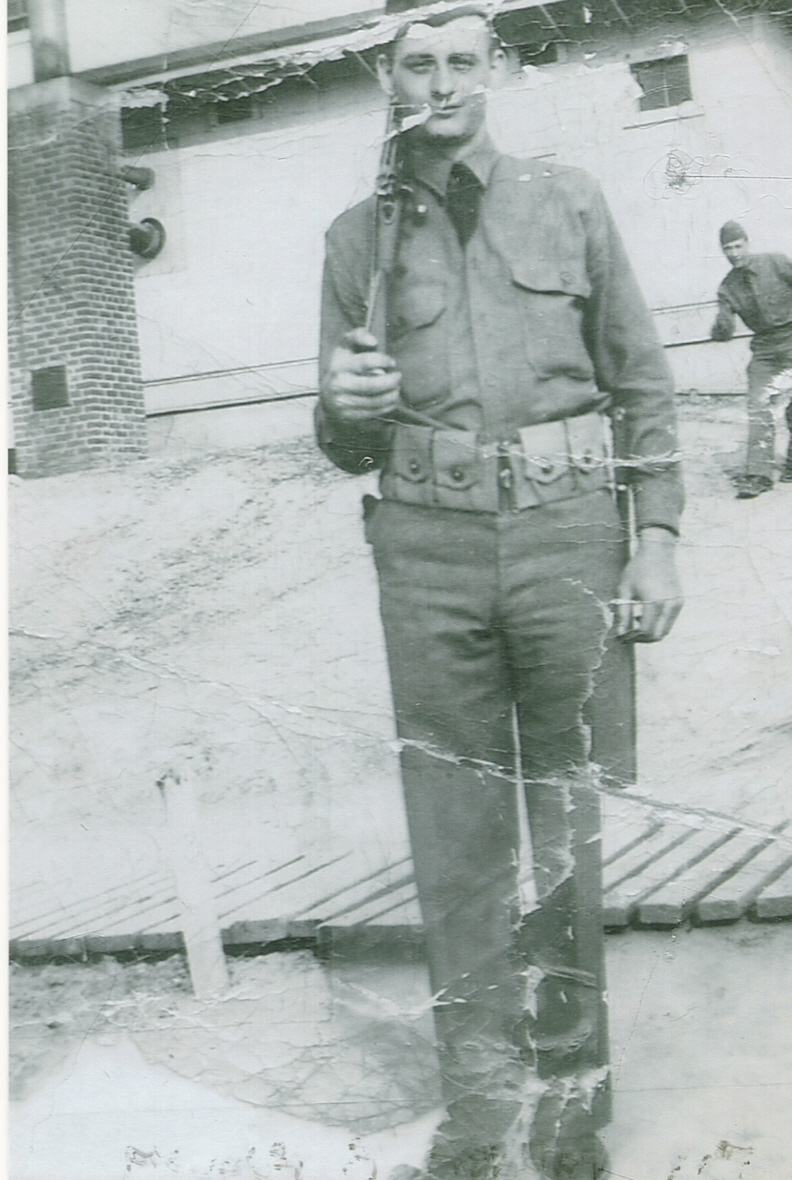
He was born on January 29, 1918 in Corry, Pennsylvania. He and his sister Virginia followed their parents, Francis and Hildur to Erie, an industrial city on the Lake Erie, bordering with Canada, in 1925. He married Jean Kuhn. They had a son, Eric. Before the war, he worked as a qualified typesetter. On February 25, 1942, he received his mobilization and showed up on the very next day, date on which he was recognized as fit for duty.
On November 9, his wife Jean gave birth to their son Eric. The private FULLOM followed the regiment to Alliance Air Force Base, Nebraska on March 20, 43. On July 1, 43, he had his first leave of 15 days since his incorporation. Permission during which he certainly saw his son for the first time. In October 43, he received a promotion and became Private First Class.
The regiment remained there for 2 weeks, after which it was transferred to Fort Hamilton, Brooklyn to await embarkation for the Atlantic crossing. This fort historically defended New York's port facilities. There is still a garrison there today.
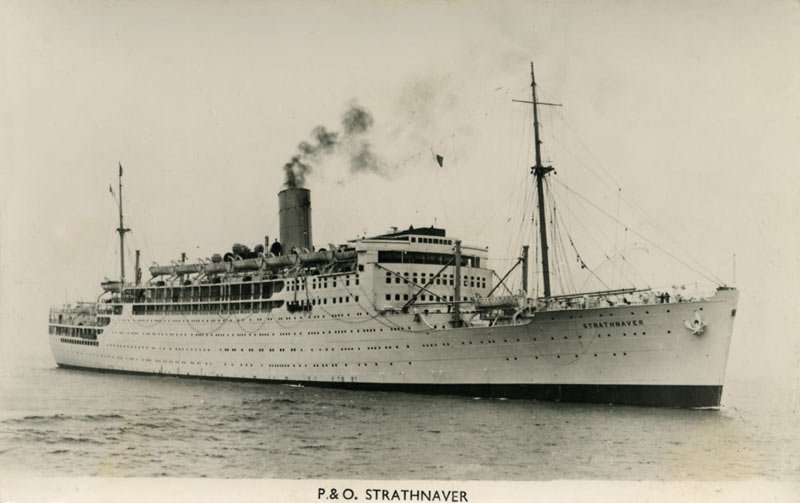
From Scotland, the 507 was transferred to Ireland, to Portrush, where the men underwent extensive training including night jumps. In February 44, Fullom was promoted to the rank of Tech 5, corporal technician. In March 44, the regiment was deployed near Nottingham, in a camp of pyramids shared by groups of 6 men. There, the Tech 5 Fullom followed the training to prepare for the invasion. Map reading, field exercise, German and French lessons, first aid and finally participated on May 12 in the maneuver called Eagle. A dress rehearsal of the 82nd Airborne for d-Day. On the 27th, shortly before D-Day, he was promoted to the rank of Tech 4. The next day, the HQ Company of the regiment and those of the 1st battalion and companies A, B and C went to Fullbeck. There, the members of the command companies, including Fullom, studied the maps and models of the objectives assigned to them. On June 3, Fullom helped attach the containers to the C47 to which he was assigned. On the afternoon of the 4th, Fullom and the other members of his stick equipped themselves, like all the other paratroopers before they were told that the departure was postponed to the next day due to bad weather affecting their target. On June 5, late at night, Fullom finally embarked on his destiny. At 11:50 a.m., his plane took off. On June 15, he was pronounced dead. The personal experience of Tec 4 Fullom between June 6 and June 14, when he was killed, is not known.

We know, however, that he was parachuted near Ste-Mère Eglise at 2:30 a.m. near Drop Zone T, the starting point of his unit and that he was killed on the night of 14 near the Village of La BONNEVILLE, village on the road of the 82nd in its offensive of the 14th towards Saint-Sauveur le Vicomte. Battle of St Sauveur le Vicomte  He had written a letter to his parents on June 7 in which he told them that he had taken part in the invasion and that he was doing well. We can only assume, but it's a safe bet that the Tec4 Fullom after landing near St-Mère Eglise, quickly managed to join his unit, since the drop zone T assigned to his regiment was not very far, or he joins a mixed unit made up of isolated paratroopers grouping together. Either way, he rejoined his unit before the June 14 offensive on St Sauveur. |
||||||||||||||||||||||||||


Activated/Activé |
Normandy/Normandie |
| 25 Mar 1942 | Days of Combat/Jour de Combat 422 |
| Casualties/Victimes 9 073 | |
Entered Combat/Entré au combat |
|
| 9 Jul 1943 at Sicily | |
|
Commanding Generals/Commandants généraux Maj. Gen. Omar Bradley (Mar 42 - Jun 42) |
Campaigns/CampagnesSicily (9 Jul - 17 Aug 43) Normandy (6 Jun 44 - 24 Jul 44) Rhineland (15 Sep 44 - 21 Mar 45) |
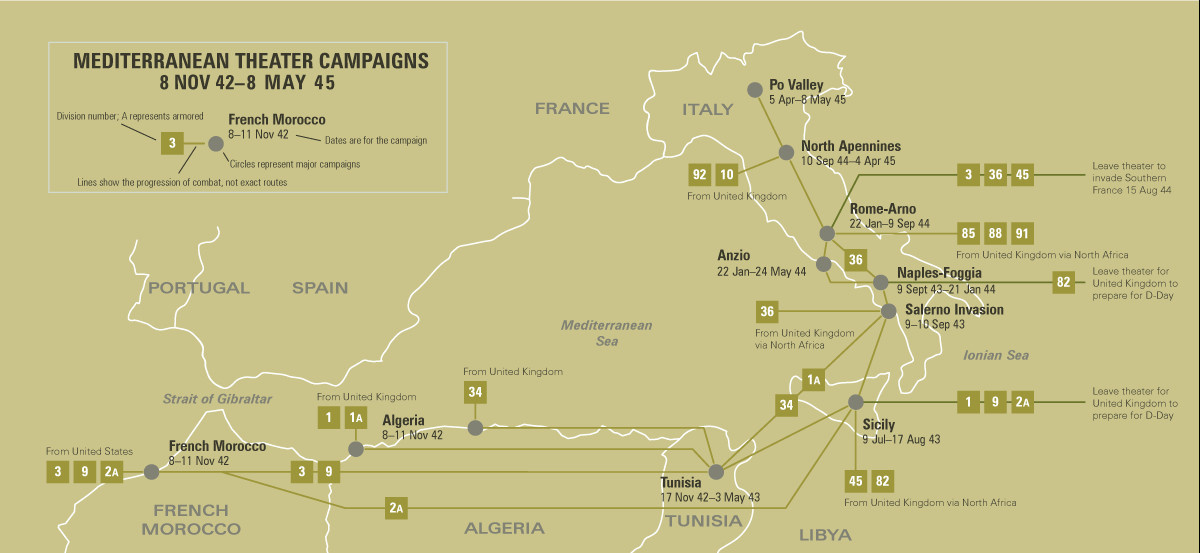
CARTE DE CAMPAGNE DU THÉÂTRE MÉDITERRANÉENCAMPAIGN MAP OF THE MEDITERRANEAN THEATER |
|
 |
|
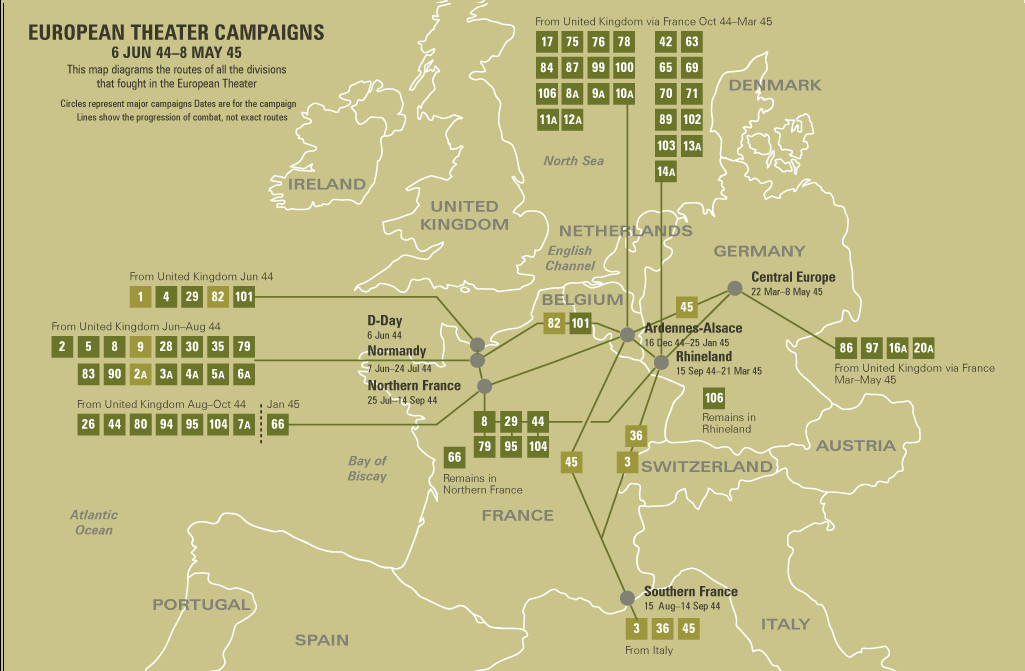
PLAN DE ROUTE DE LA CAMPAGNE - CAMPAIGN ROUTE MAP |
|
 |
|
DIVISION CHRONICLEThe 82d Airborne Division landed at Casablanca, 10 May 1943, and trained. Elements first saw combat in Sicily, when the 505th RCT and part of the 504th dropped behind enemy lines, 9-10 July 1943, at Gela. The remainder of the 504th RCT dropped, 11-12 July 1943, also near Gela, after running friendly naval and ground force fire. Scattered elements formed and fought as ground troops. The elements were flown back to Tunisia for reequipment and returned to Sicily to take off for drop landings on the Salerno beachhead. The 504th Parachute Infantry dropped, 13 September 1943, and the 505th the following night; the 325th landed by boat. These elements bolstered Salerno defenses and fought their way into Naples, 1 October 1943. After a period of occupation duty (and combat for some elements in the Volturno Valley and Anzio beachhead), the Division moved to Ireland, November 1943, and later to England, February 1944, for additional training. Moving in by glider and parachute, troops of the 82d dropped behind enemy lines in Normandy on D-day, 6 June 1944, before ground troops hit the beaches. Cutting off enemy reinforcements, the Division fought its way from Carentan to St. Sauveur-le-Vicomte, fighting 33 days without relief. Relieved on 8 July, it returned to England for refitting. On 17 September, it was dropped at Nijmegen, 50 miles behind enemy lines, and captured the Nijmegen bridge, 20 September, permitting relief of British paratroops by the British 2d Army. After heavy fighting in Holland, the Division was relieved 11 November and rested in France. It was returned to combat, 18 December 1944, to stem the von Rundstedt offensive, blunting the northern salient of the Bulge. It punched through the Siegfried Line in early February 1945, and crossed the Roer, 17 February. Training with new equipment in March, the Division returned to combat, 4 April, patrolling along the Rhine, securing the Koln area, later moving across the Elbe, 30 April, into the Mecklenburg Plain, where, 2 May 1945, the German 21st Army surrendered. |
CHRONIQUE DE DIVISIONLa 82ème division aéroportée a atterri à Casablanca le 10 mai 1943 et s'est entraînée. Les éléments ont d'abord été combattus en Sicile, lorsque le 505ème RCT et une partie du 504ème ont été largués derrière les lignes ennemies, du 9 au 10 juillet 1943, à Gela. Le reste de la 504ème RCT est tombé, du 11 au 12 juillet 1943, également près de Gela, après des tirs amicaux contre des forces navales et terrestres. Des éléments épars se sont formés et se sont battus en tant que troupes au sol. Les éléments ont été rapatriés en Tunisie pour le rééquipement et sont retournés en Sicile pour décoller pour atterrir sur la tête de pont de Salerne. Le 504th Infantry Parachute Infantry est tombé le 13 septembre 1943 et le 505ème le lendemain soir; la 325ème atterrit en bateau. Ces éléments ont renforcé les défenses de Salerno et se sont introduits à Naples, le 1er octobre 1943. Après une période d'occupation (et de combat pour certains éléments dans la vallée de Volturno et la tête de pont d'Anzio), la division s'est installée en Irlande en novembre 1943 , Février 1944, pour une formation supplémentaire. Se déplaçant en planeur et en parachute, les troupes du 82d tombèrent derrière les lignes ennemies en Normandie le 6 juin 1944, avant que les troupes terrestres ne frappent les plages. En coupant les renforts ennemis, la Division se fraya un chemin de Carentan à Saint-Sauveur-le-Vicomte, combattant 33 jours sans soulagement. Soulagé le 8 juillet, il est retourné en Angleterre pour y être réaménagé. Le 17 septembre, il a été largué à Nimègue, à 50 milles derrière les lignes ennemies, et a capturé le pont de Nimègue, le 20 septembre, permettant ainsi à la 2 e armée britannique de soulager les parachutistes britanniques. Après de violents combats en Hollande, la division est soulagée le 11 novembre et se repose en France. Il fut remis au combat le 18 décembre 1944 pour endiguer l’offensive de von Rundstedt, assourdissant le saillant septentrional des Ardennes. Il a percuté la ligne Siegfried au début de février 1945 et a traversé la Roer le 17 février. S'entraînant avec de nouveaux équipements en mars, la Division est revenue au combat le 4 avril, patrouillant le long du Rhin, sécurisant la région de Koln, traversant ensuite l'Elbe le 30 avril dans la plaine de Mecklenburg où, le 2 mai 1945 s'est rendu. |
| SOURCE INFORMATION & PHOTO | Armydivs.squarespace.com |
|---|
| SOURCE INFORMATION & SOURCE PHOTO | Findagrave.com - Clive TIRLEMONT - Usairborne.be - - Don.genemcguire.com Dday-overlord.com |
|---|---|
| PROGRAMMEURS | Eric, Henri, Garrett, Clive, Frédéric & Renaud |