


|
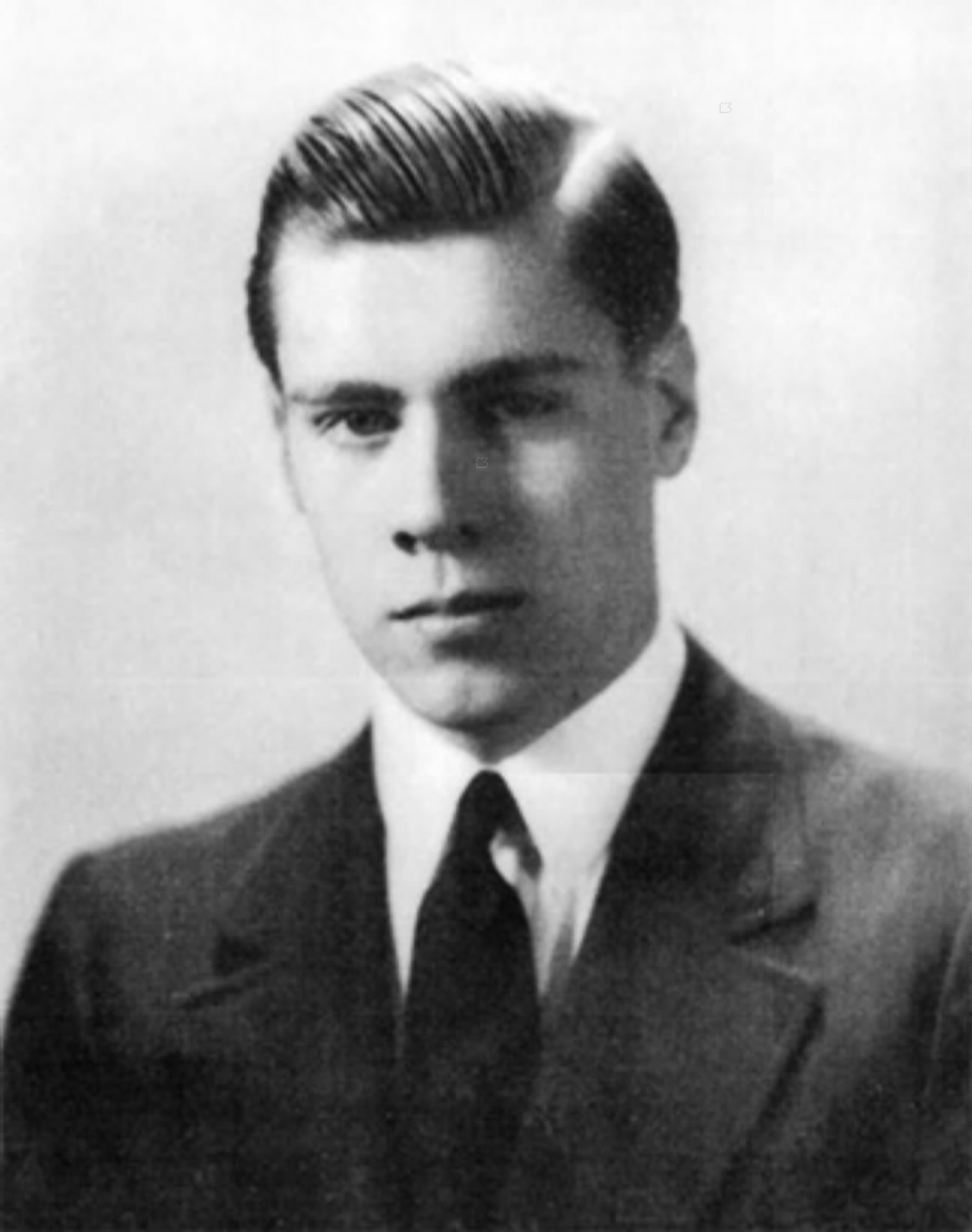
Frank E BENSON Jr
| |||||||
|---|---|---|---|---|---|---|---|
|
Source : Fold3 | |||||||
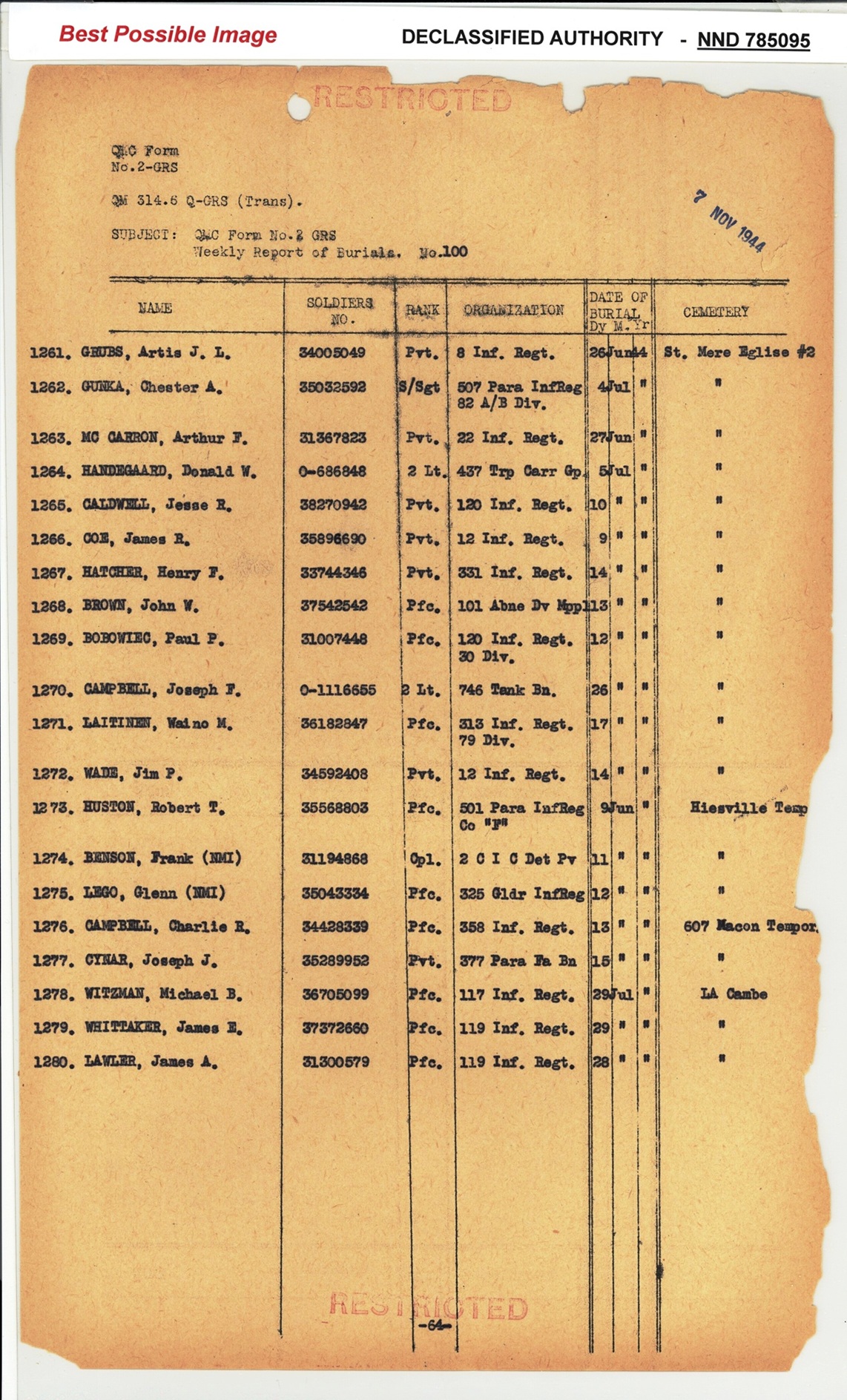
| NUMBER OF SERVICE | 31194868 | ||||||
| AGE | 25 yo | ||||||
| DATE OF BIRTH | 25 October 1918 | ||||||
| ENLISTMENT STATE | CONNECTICUT | ||||||
| FAMILY |
Parents : Frank E & Arline Whitehead BENSON Siblings : Carolyn M, Arthur W & Arline G | ||||||
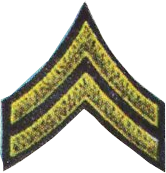
| RANK |
| ||||||
| FONCTION | Counter intelligence operator | ||||||
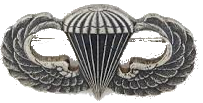
| JOB BEFORE ENLISTEMENT | University of Connecticut student |  | |||||
| DATE of ENLISTEMENT | |||||||
| COMPANY | Counter Intelligence Corps Detachment | ||||||
| BATTALION | HeadQuarters Battalion (detached) | ||||||
| DIVISION GROUP | 101st Airborne Division | ||||||
| ARMY | 1st Army | ||||||
| DATE OF DEATH | 6 June 1944 |
Source : Andy | |||||
| STATUS | KIA | ||||||
| PLACE OF DEATH | Surroundings of Ste-Marie-du-Mont/ Hiesville | ||||||
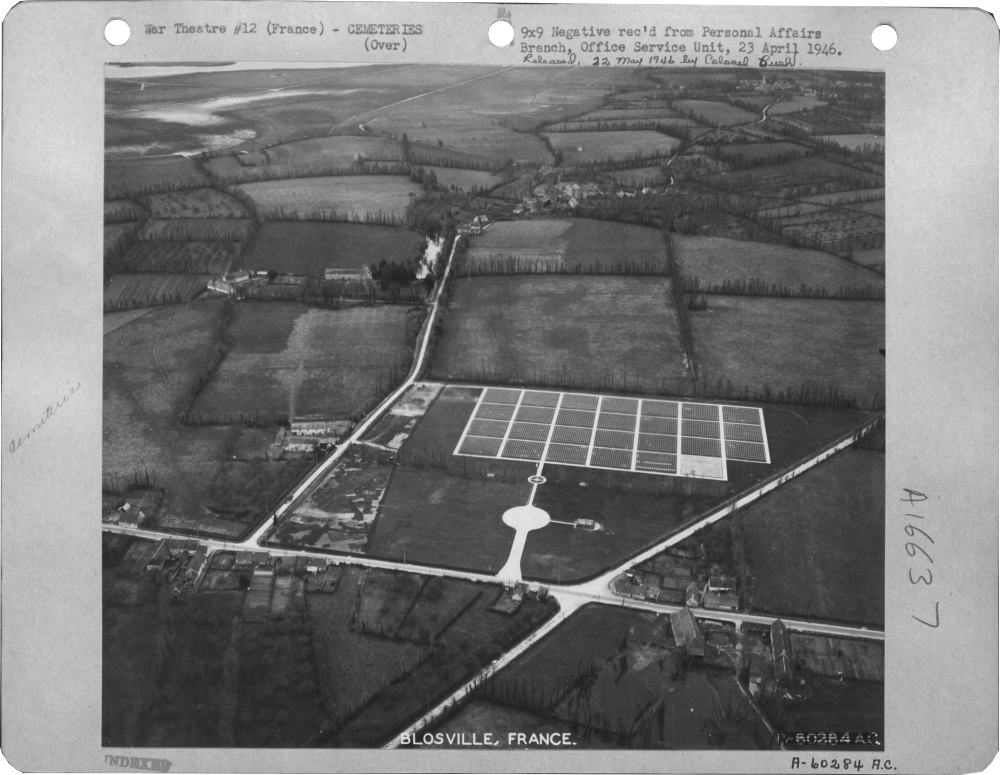
| CEMETERY TEMPORARY |
CEMETERY TEMPORARY of Blosville N°3508
| ||||||
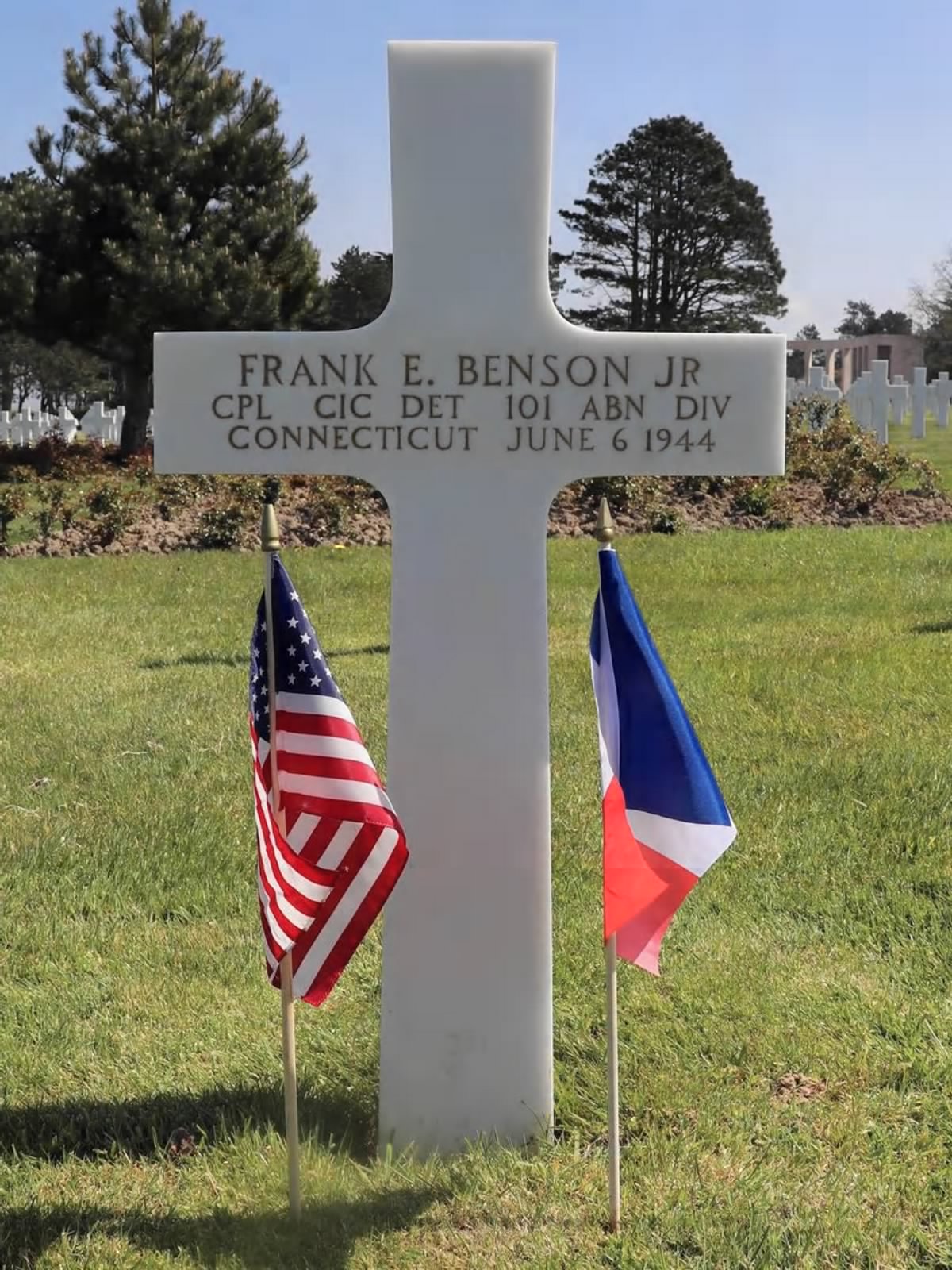
| CEMETERY | NORMANDY AMERICAN CEMETERY of Colleville | ||||||
| GRAVE |
| ||||||
| DECORATION & BREVET |
| ||||||
| |||||||
| STORY | |||||||
|
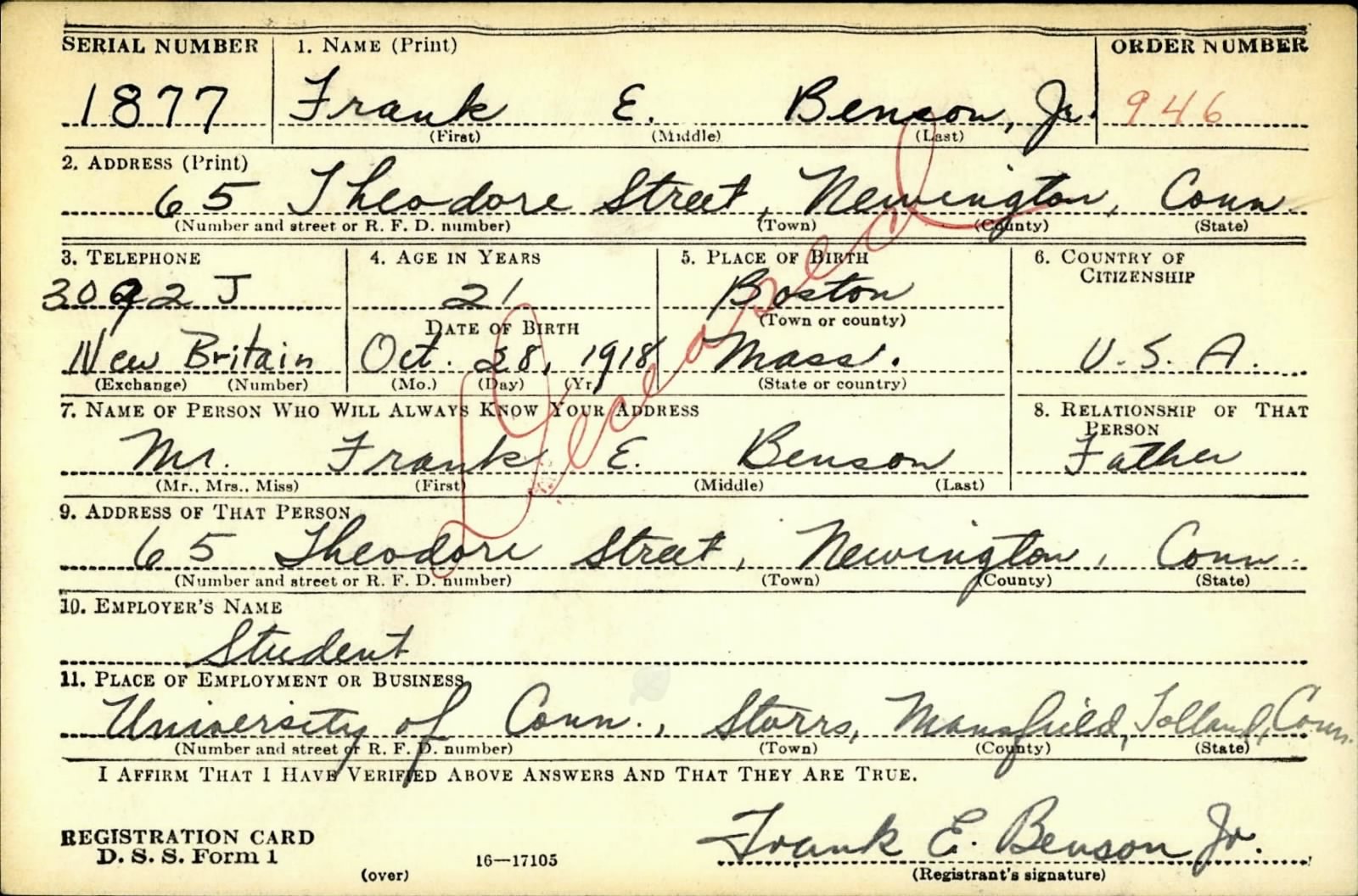
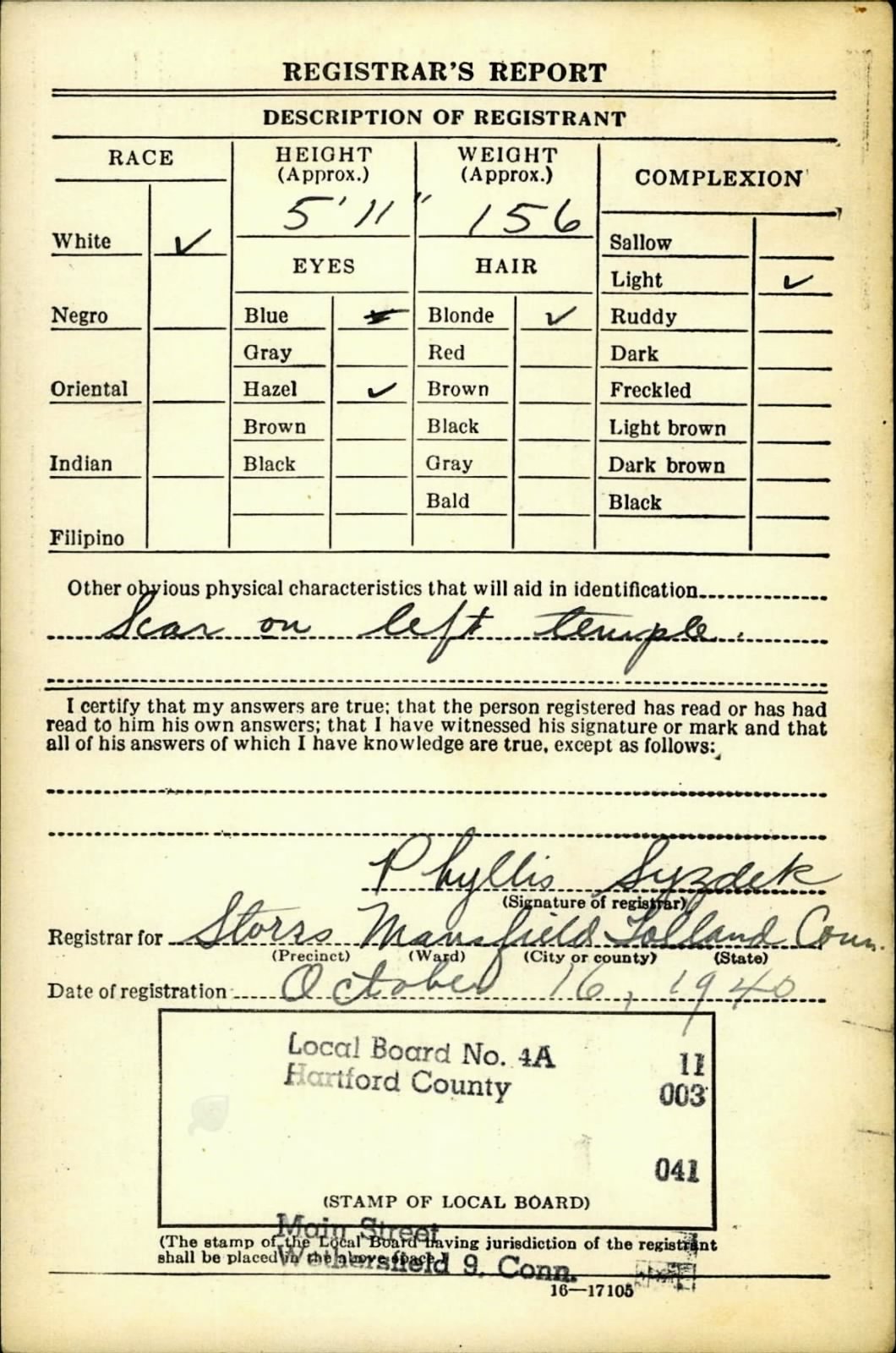
Frank Edwin Benson, Jr was born October 28, 1918 in Boston, Massachusetts to Frank Edwin and Arline M Whitehead Benson. He was the second of four children. His siblings were: Carolyn M (1 year older), Arthur W (8 years younger), and Arline G (10 years younger). His younger brother, Arthur, died in 1931 at the age of 4 in an auto accident which occured in front of the family home. In the 1930 and 1940 US Censuses the family was living in Newington, Hartford, Connecticut. Frank Sr was working in the steel industry possibly as a mechanic. Frank Jr completed his WW2 Draft Card on June 16 1940 while he was a student at the University of Connecticut and listed his father as his contact person. By the time he enlisted in the Army in June 1942, Frank had graduated from UConn. His page on the HonorStates website states that he worked ‘undercover’ after his graduation. Frank was assigned to the 101st Airborne Division and was a member of the 101st Counter Intelligence Corps Detachment. The following is directly quoted from _Counter Intelligence Corps History, Volume XIV, _‘The Liberation of France: Part 1--Normandy’ (March 1959). "Few events in world history can rival in magnitude the Allied invasion of Normandy in June 1944. Within twenty-five days after the initial assault on 6 June, one million men and more than 560, 000 tons of supply were landed on the northern coast of France in the most gigantic amphibious assault ever attempted. For the Counter Intelligence Corps (CIC), the events of 6 June 1944 marked the - beginning of a vital assignment that thrust its agents into every phase of the 336-day drive across Europe. CIC detachments were with sixty-five divisions, fourteen corps, six armies and two army groups, besides Supreme Headquarters Allied Expeditionary Force (SHAEF) and European Theater of Operations (ETO) Headquarters staffs and numerous Communications Zone units." "H-Hour for the amphibious assault was 0630, but when the first waves of infantry swept ashore, after skirting or blasting a path through hundreds of treacherous underwater obstacles, airborne troops had been fighting the battle of Normandy for five hours. The 101st Airborne Division had begun dropping southeast of the town of Ste. Mere-Eglise, behind UTAH Beach, at about 0130, and the 82d Airborne Division in an area northwest of the 101st at about 0230. CIC agents with both U.S. Airborne divisions jumped with the first wave of paratroopers." "The 101st CIC Detachment, which was the first to be thrown into the confusion that prevailed for the forty-eight hours following the invasion, suffered the heaviest casualties of any detachment during the ETO campaign. Three days before the invasion, Captain Martin McGuire, who was to command the 101st throughout the ETO Campaign, joined the detachment. He had little time to brief his men and no time for a practice jump. This was to be his first." "Seven men were selected to accompany him… The remaining agents of the seventeen-man detachment were to come in later that day by landing craft. Each of the eight men was assigned to a different plane in the hope of minimizing casualties since it was felt that men of their specialized training could not be easily replaced. In spite of this precaution, upon landing the group was reduced to three when [three agents] were killed, [one] seriously wounded, and [one] wounded and captured when he landed directly atop a German Command Post." (He was rescued two months later by U.S. troops as they advanced through Normandy). "Like the other troops of the 101st Airborne Division, these eight men watched the dusk fall slowly on the evening of 5 June 1944, as, joined with small groups at a half-dozen air fields in southern England, they made final checks on their weapons and attended to other last minute preparations. The tension was broken once by an unexpected visit by General Eisenhower. The Supreme Allied Commander, fully aware of the dangers which lay ahead for the paratroopers, visited each airdrome, talking with the men and offering a few words of encouragement." "After what seemed like an eternity the men boarded their DC-6s, their faces blackened and their bodies burdened under eighty pounds of equipment. One by one the planes wheeled into position and within an hour all the troop carriers were air-borne and formed into groups. Accompanied by heavy fighter escort, they at last moved out across the Channel in the direction of Normandy… As the first wave of planes neared the coast, German flak soon caused the air fleet to scatter in all directions." "At approximately 0200, the first American paratroopers jumped, landing over an area of twenty-five by fifteen miles square. By dawn, Major General Maxwell Taylor had rallied only 1,100 of his 6,000 men at the appointed rendezvous to begin the desperate fight to contact beachhead forces. CIC agents of the 101st had been provided with so-called "Grey-Lists," names of persons who might be expected to be valuable as informants, but these lists proved in most instances to be inaccurate and outdated. However, there was little time for CIC work, as such, during the first hours, as CIC agents, like the combat troops, were trying to stay alive and fighting desperately to establish contact with other U.S. units." "Before ten days had passed, more than three hundred CIC agents had taken part in the invasion. In spite of all the confusion of these first days, they had, with intelligence and enthusiasm, gone about their assigned missions of guarding against threats to military security, searching for enemy documents and establishing liaison with local citizens. They had firmly established themselves as part of the combat team." Information on the HonorStates website says that Corporal Benson was trained as a Paratrooper and died parachuting into France. He must have been one of the 7 men who accompanied Captain McGuire and died as a result. Corporal Benson is buried in the Normandy American Cemetery and Memorial in Colleville-sur-Mer, France. He gave his life in the service of his country. We will always remember his story. This story is part of the Stories Behind the Stars project (see www.storiesbehindthestars.org). This is a national effort of volunteers to write the stories of all 400,000+ of the US WWII fallen here on Fold3. Can you help write these stories? Related to this, there will be a smart phone app that will allow people to visit any war memorial or cemetery, scan the fallen's name and read his/her story. Added by: fronkfam403 | |||||||
|
Source : Fold3 |
Source : Fold3 | ||||||
|
Source : Rcelt | |||||||
|
Source : Victor Daniel | |||||||







| SOURCE INFORMATION & SOURCE PHOTO | Victor DANIEL - abmc.gov - archives.gov - fr.findagrave.com - ancestry.com - www.army.mil - www.honorstates.org - www.dday-overlord.com - Fold3 |
|---|---|
| EDITORS | Victor, Jean-Philippe, Eric, Henri, Garrett, Clive, Frédéric & Renaud |