

|
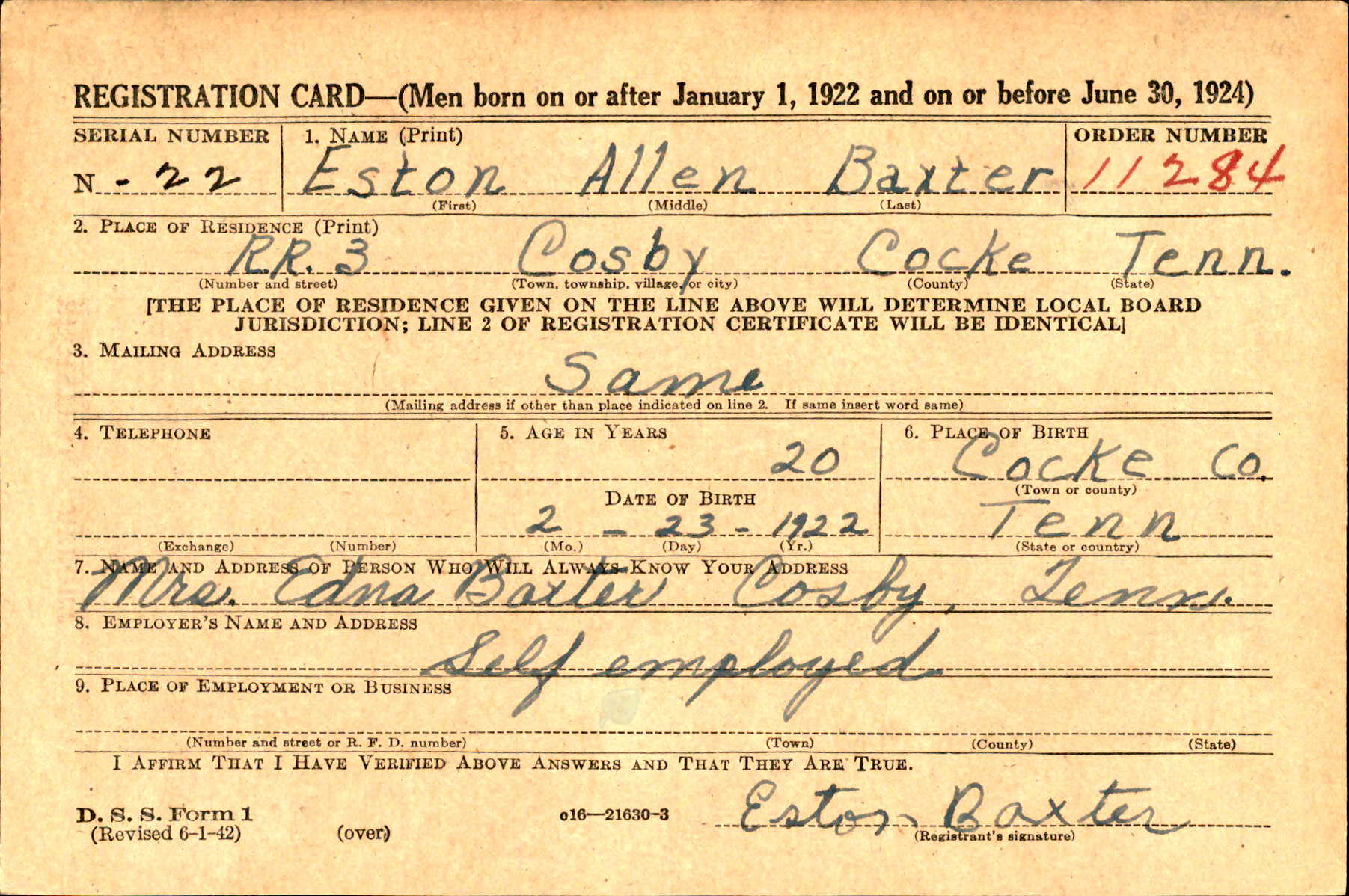
Eston Allen BAXTER
| ||||||||||||||||||||||||||
|---|---|---|---|---|---|---|---|---|---|---|---|---|---|---|---|---|---|---|---|---|---|---|---|---|---|---|
|
Source : | ||||||||||||||||||||||||||
| NUMBER OF SERVICE | 34490992 | |||||||||||||||||||||||||
| AGE | 22 yo | |||||||||||||||||||||||||
| DATE OF BIRTH | 23 February 1922 Cocke County, TENNESSEE | |||||||||||||||||||||||||
| ENLISTMENT STATE | TENNESSEE | |||||||||||||||||||||||||
| FAMILY |
Parents : Jasper Allen & Edna Valentine BAXTER Siblings : Fred Greer & Frank Green | |||||||||||||||||||||||||
| RANK |
| |||||||||||||||||||||||||
| FONCTION | Infantry Man | |||||||||||||||||||||||||
| JOB BEFORE ENLISTEMENT | Farmer |  | ||||||||||||||||||||||||
| DATE of ENLISTEMENT | 1942 | |||||||||||||||||||||||||
| COMPANY | Company B | |||||||||||||||||||||||||
| BATTALION | ||||||||||||||||||||||||||
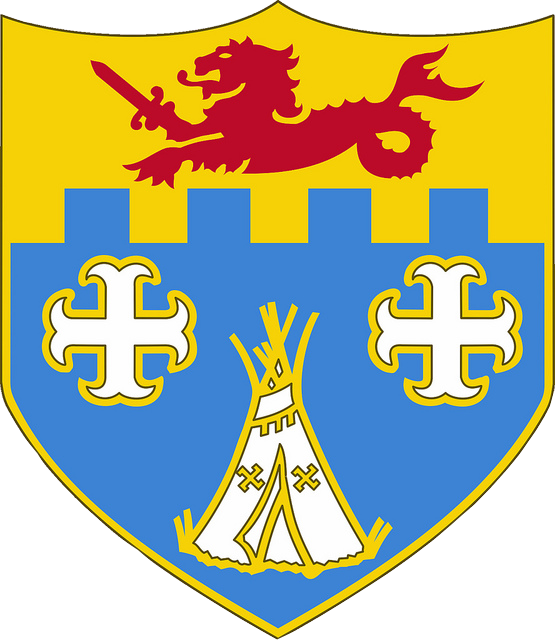
| REGIMENT | 12th Infantry Regiment | |||||||||||||||||||||||||
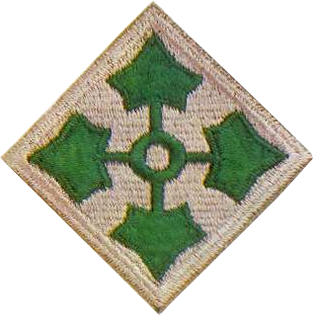
| DIVISION | 4th Infantry Division | |||||||||||||||||||||||||
| DATE OF DEATH | 24 June 1944 |
Source : willowmere | ||||||||||||||||||||||||
| STATUS | KIA | |||||||||||||||||||||||||
| PLACE OF DEATH | Digosville | |||||||||||||||||||||||||
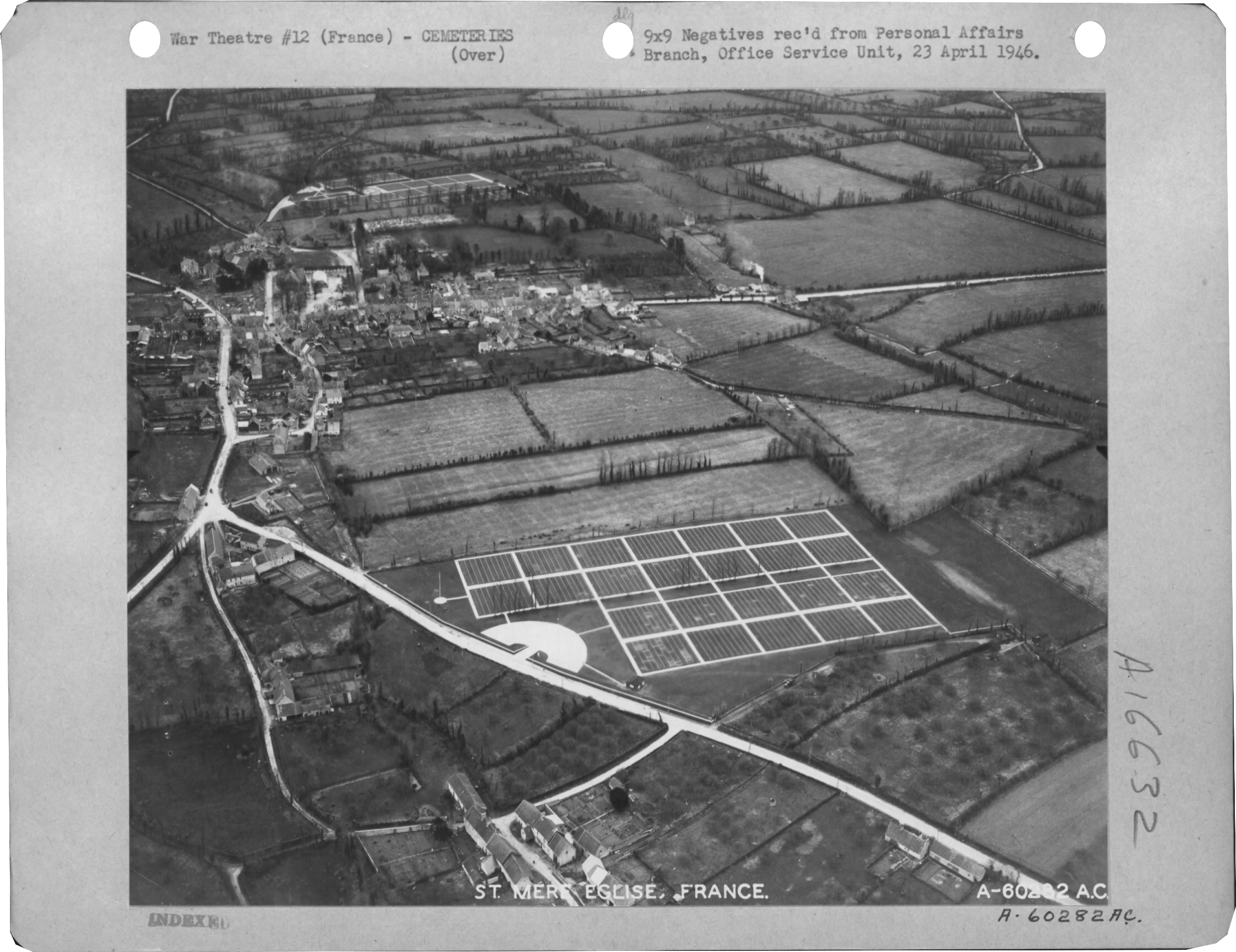
| CEMETERY TEMPORARY |
CEMETERY TEMPORARY of Sainte Mère Eglise #2 N°3586
| |||||||||||||||||||||||||
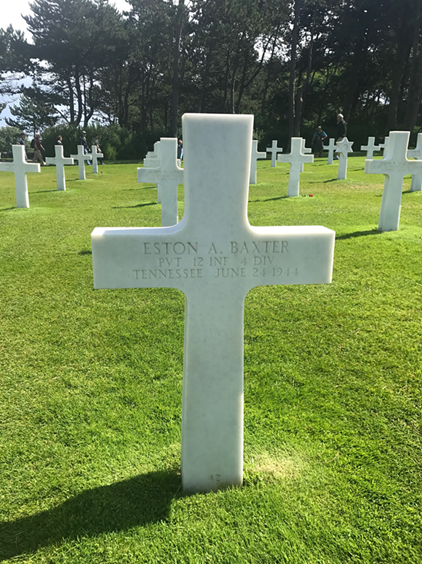
| CEMETERY | NORMANDY AMERICAN CEMETERY of Colleville | |||||||||||||||||||||||||
| GRAVE |
| |||||||||||||||||||||||||
| DECORATION & BREVET |
| |||||||||||||||||||||||||
| ||||||||||||||||||||||||||
| STORY | ||||||||||||||||||||||||||
|
Source : Etvma.org | ||||||||||||||||||||||||||
|
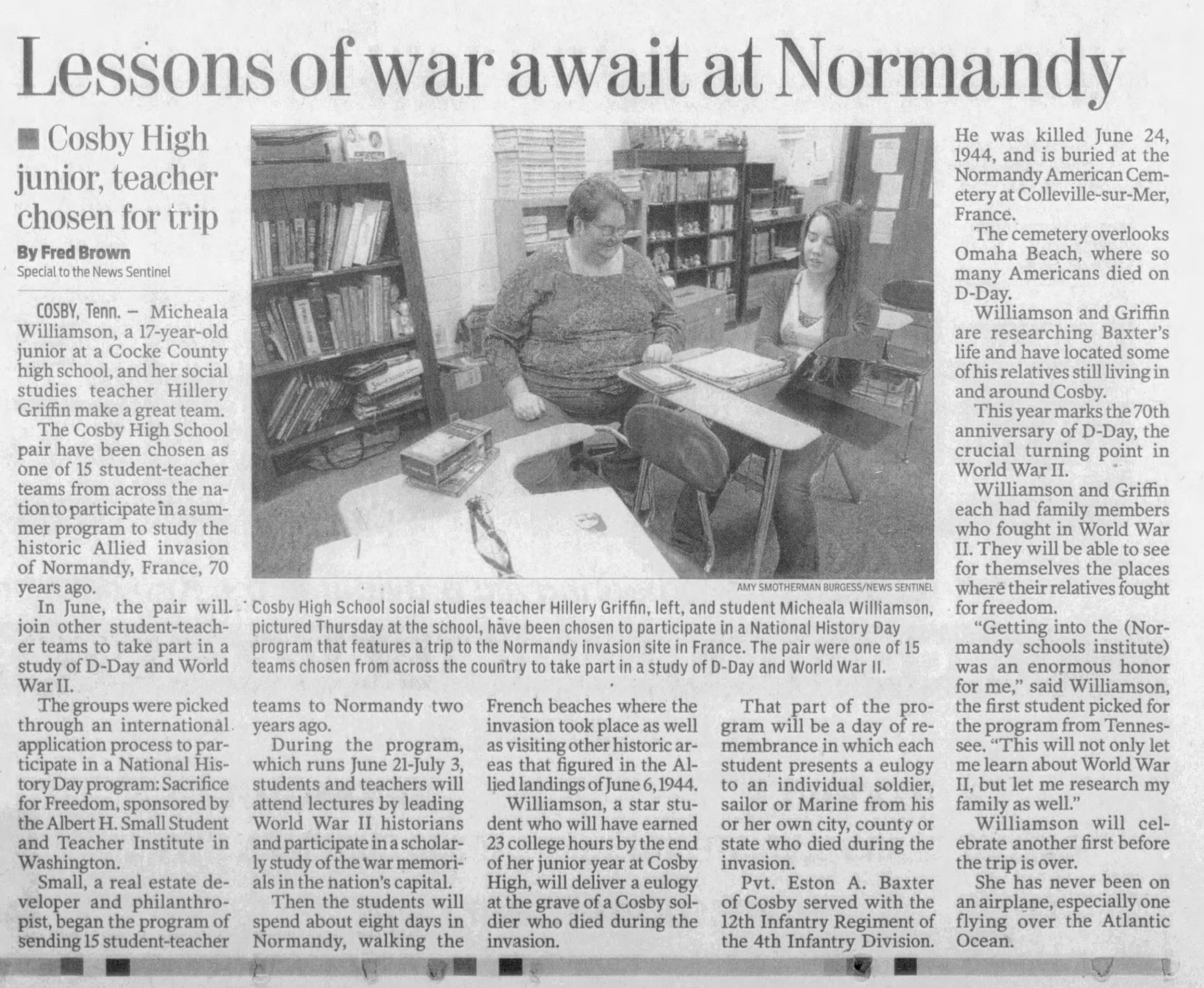
Contributed by Caley Williamson
|
Eston Baxter was born on February 13, 1922, in Cosby, Tennessee, the firstborn of Edna Valentine and Jasper Allen Baxter. He had two younger brothers, Fred Greer Baxter, born in 1929, and Frank Baxter, born in 1935. His family worked as farmers. In 1930, they lived on his grandfather Green Valentine’s 75-acre farm. Eston completed six years of school before leaving, probably to work on the farm. In 1940, Eston became the man of the house at age 18, following his father and grandfather’s deaths. His family lived on a new 70-acre farm on Caney Creek. Eston and his mother supported his siblings, 11-year-old Greer and 3-year-old Frank, and his 11-year-old cousin, Imogene, who lived with the family. | |||||||||||||||||||||||||
HomefrontEston Baxter lived his entire life before the war in Cosby, Tennessee, in Cocke County. Tennessee was busy during the war years. Oak Ridge became one of the main sites for the secret Manhattan Project. The enriched uranium produced here helped build the atomic bombs that ended the war. Like most rural counties, Cocke County relied on agriculture to support itself. Farms covered most of the land. Livestock owners struggled with the ration system. If a farmer wanted to sell his hogs, he had to save up enough gas coupons to take them to slaughter. In the town of Newport, Bush’s and Stokely’s were two large employers, both in the canned food industry. Many Cocke County natives made illegal moonshine to support themselves. The rationing once again hampered their trade, as sugar is required to make moonshine. Churches were incredibly supportive of the war. They would put up banners with stars on them, representing each soldier. If a boy died, his blue star would turn gold. When a boy returned home from war, he got to keep his star. Church bulletins had addresses, updates on soldiers, and even soldiers of the week. Cocke County had two movie theaters. They were the local hangouts, and many went just because of the chance to see a loved one on the newsreels. Overall, the war broadened the small town’s horizons. Now they knew the names and locations of foreign locations and had reason to take an interest outside of local affairs. |
Source : Etvma.org | |||||||||||||||||||||||||
Military ExperienceEston Baxter was drafted in 1942 into the 113th Infantry Regiment but transferred sometime between April and June 1944 to the 4th Infantry Division, 12th Infantry Regiment, 1st Battalion, B Company. It is not clear when he landed in the Normandy campaign (he may have arrived on D-Day or later as a reinforcement). On the morning of June 6, 1944, the 4th Infantry Division landed on Utah Beach. They faced less enemy resistance than other beaches, and by noon, the 12th Infantry Regiment joined with the 8th and 22nd Infantry Regiments to push inland. In the next few days, the 12th Infantry Regiment advanced inland, supported by reinforcements. They faced heavy attacks on June 7-8 for control of Azeville Road. They faced heavy attacks, including a counterattack in the afternoon of June 8 from a German bicycle unit carrying machine guns. For his leadership during the counterattack, Lieutenant Colonel Charles Jackson received a Distinguished Service Cross. They succeeded and advanced across the Montebourg-St. Floxel Road with the assistance of a tank battalion. Reinforcements joined the 12th Infantry Regiment on June 12. They were able to capture Montebourg and were close to Valognes, a critical rail and road center of the Cotentin Peninsula. The unit regrouped and resupplied from June 13 to June 19. During this time, they conducted patrols and encountered a series of smaller engagements against the enemy. On June 19, they advanced under radio silence to take two hills that the Germans were using for artillery fire. The advance was costly – many officers were lost, and the medical station was hit. At 7:30 a.m. on June 24, the 1st Battalion was paired with six tanks to take the high ground north of Digisville, France. Allied forces bombed the enemy strongpoints, causing casualties. The battalion paused to reorganize and became pinned down but was saved by the tanks. The 1st Battalion captured a German command post containing valuable documents. Company B took 225 Prisoners of War. As they prepared for their next objective, a scouting party was hit by friendly fire. From the high ground, they saw vehicles fleeing into Cherbourg. By 9:40 p.m., they cut off the road and isolated the Germans defending an airfield from attack. During the night, the 1st Battalion seized several anti-aircraft guns, a searchlight, and ammunition. Company B captured an additional 395 prisoners. Sometime during this day, Private Eston Baxter was hit and killed in action. The 12th Infantry Regiment led the 4th Infantry Division march into Cherbourg. The port was captured and forced to turn toward Paris. A month later, the Baxter family received the telegram. His brother remembered that it was a Sunday and that their mother knew right away what the cars coming up the road meant because it was rare to see vehicles on that road. | ||||||||||||||||||||||||||
|
Source : Etvma.org | ||||||||||||||||||||||||||
EulogySome lives are quiet. So quiet, it seems that they never existed. I began to realize this when I researched the life of Private Eston A. Baxter. He lived on a small family farm in the sleepy town of Cosby, Tennessee. We share a hometown and a common ancestor. His family didn’t have much money; his father died when Eston was only 17. Eston was forced to grow up prematurely to care for his elderly grandfather, his mother, two younger brothers, and a younger cousin. He was no stranger to hard work. To his family’s dismay, he was drafted in 1942, and throughout his wartime experience, he wrote countless letters to his family. He wrote to his momma, to his little brother Frank-his little buddy-who, at age five, couldn’t even read yet, and to his many girlfriends back home-some of whom did not always write back. He told them how he was doing and asked if they were well. In one letter, he wrote of a man getting discharged. “I wish it was me, momma,” he wrote. He once asked his mother for money to get home on furlough, claiming he would hitchhike if he had to. He always signed his letters, “So answer soon,” which only reiterated that he longed to return to his small home in the mountains. His last letter was written on June 17, 1944, from somewhere in France, and the next news his family received was a telegram announcing he had been killed in action. His little brother remembers the day well because “they all knew what the car in the driveway meant.” Eston gave the ultimate sacrifice for his country, yet the memory of his life fades with time. His youngest brother was so small when Eston left for the war that he has very little memory of him. His niece only knew that her father encouraged her grandmother to leave his remains in France, buried amongst the men he served and died with during the war. While she never knew him personally, she enjoyed learning about his life along with us. You will not find his name in a history book, nor will you find the names of countless others who have died in the name of war. Today we honor a soldier buried in this cemetery to keep his memory alive for a little longer so that his legacy will not be buried with him. To Eston, you have inspired me to push myself a little harder, to make the most of the time we do have. Life is not always; when the world needed them most, there were the men who answered the call. Each soldier not only bore the weight of his pack but the burden of sacrifice. These men are the reason we are standing here today. They enabled democracy to continue, and we must honor them by continually seeking to do better for the future. William Faulkner wrote, “The past is not dead. It’s not even past.” This is closely reflected in the world the Normandy invasion made possible. Like Eston, most of the soldiers buried here led quiet lives, but the impact of their actions echoes loudly and shakes all who listen. | ||||||||||||||||||||||||||






Activated/Activé |
Normandy/Normandie |
| 1 Jun 1940 | Days of Combat/Jour de Combat 299 |
| Casualties/Victimes 22 660 | |
Entered Combat/Entré au combat |
|
| 6 Jun 44 D-Day | |
|
Commanding Generals/Commandants généraux Maj. Gen. Walter E. Prosser (Jun 40 - Oct 40) |
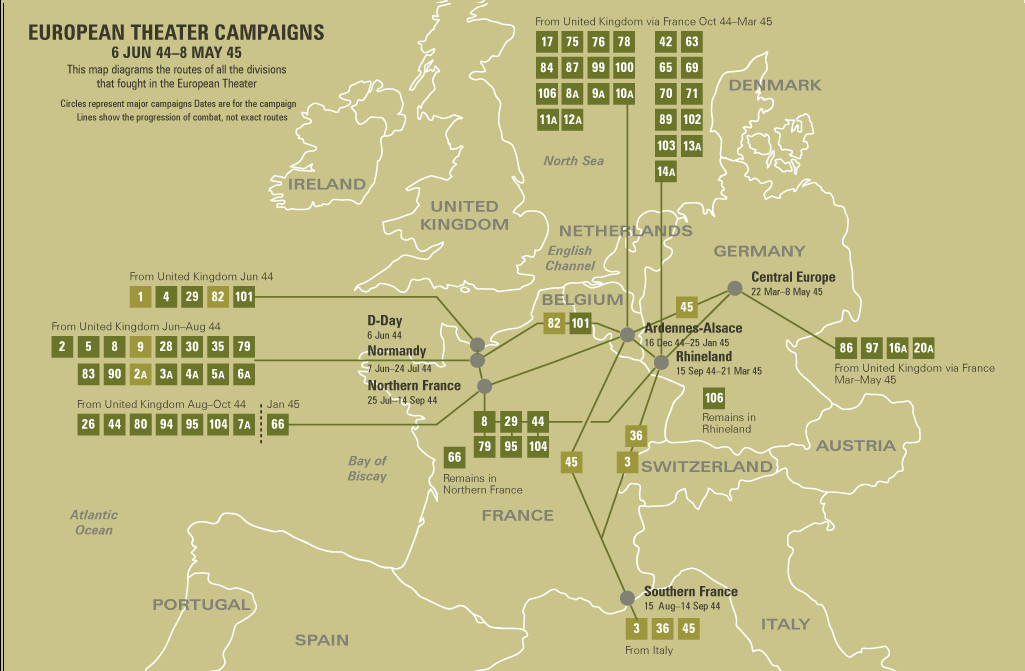
Campaigns/CampagnesNormandy (6 Jun 44 - 24 Jul 44) |
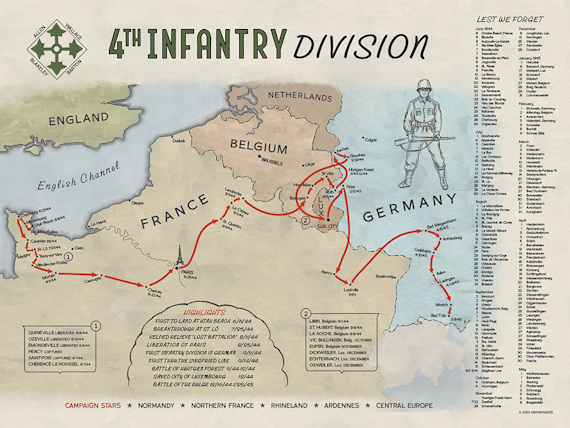
PLAN DE ROUTE DE LA CAMPAGNE - CAMPAIGN ROUTE MAP |
|
|
Source : Fanny Hubart-Salmon |
|
 |
|
DIVISION CHRONICLEThe 8th Infantry Regiment of the 4th Division was one of the first Allied units to hit the beaches at Normandy on D-day, 6 June 1944. Relieving the isolated 82nd Airborne Division at Ste. Mere Eglise, the 4th cleared the Cotentin peninsula and took part in the capture of Cherbourg, 25 June. After taking part in the fighting near Periers, 6-12 July,, the Division broke through the left flank of the German Seventh Army, helped stem the German drive toward Avranches, and by the end of August had moved to Paris, assisting the French in the liberation of their capital. The 4th then moved into Belgium through Houffalize to attack the Siegfried Line at Schnee Eifel, 14 September, and made several penetrations. Slow progress into Germany continued in October, and by 6 November the Division reached the Hurtgen Forest, where a severe engagement took place until early December. It then shifted to Luxembourg, only to meet the German winter offensive head-on, 16 December 1944. Although its lines were dented, it managed to hold the Germans at Dickweiler and Osweiler, and, counterattacking in January across the Sauer, overran German positions in Fouhren and Vianden. Halted at the Prum in February by heavy enemy resistance, the Division finally crossed 28 February near Olzheim, and raced on across the Kyll, 7 March. After a short rest, the 4th moved across the Rhine 29 March at Worms, attacked and secured Wurzburg and by 3 April had established a bridgehead across the Main at Ochsenfurt. Speeding southeast across Bavaria, the Division had reached Miesbach on the Isar, 2 May 1945, when it was relieved and placed on occupation duty. |
CHRONIQUE DE DIVISIONLe 8e régiment d'infanterie de la 4e division fut l'une des premières unités alliées à débarquer sur les plages de Normandie le 6 juin 1944, jour du débarquement. Soulager la 82nd Airborne Division isolée de Ste. Mère Eglise, le 4e défricha la presqu'île du Cotentin et participa à la prise de Cherbourg le 25 juin. Après avoir pris part aux combats près de Periers, du 6 au 12 juillet, la Division a franchi le flanc gauche de la Septième armée allemande, aidé à endiguer la route allemande vers Avranches et, à la fin du mois d'août, s'est installée à Paris, aidant les Français. dans la libération de leur capitale. Le 4e s'est ensuite déplacé en Belgique par Houffalize pour attaquer la ligne Siegfried à Schnee Eifel, le 14 septembre, et a fait plusieurs pénétrations. Les progrès lents en Allemagne se sont poursuivis en octobre et, le 6 novembre, la division a atteint la forêt de Hurtgen, où un engagement sévère a eu lieu jusqu'au début du mois de décembre. Il s'est ensuite déplacé vers le Luxembourg, seulement pour affronter l'offensive allemande d'hiver, le 16 décembre 1944. Bien que ses lignes aient été bosselées, il a réussi à tenir les Allemands à Dickweiler et Osweiler et, contre-attaquant en janvier à travers la Sauer à Fouhren et Vianden. Arrêtée au Prum en février par une forte résistance ennemie, la Division a finalement franchi le 28 février près d'Olzheim et a couru à travers le Kyll, le 7 mars. Après un court repos, le 4 mars traversa le Rhin à Worms, attaqua et sécurisa Wurzburg le 29 mars et, le 3 avril, il établit une tête de pont sur le Main à Ochsenfurt. Accélérant le sud-est à travers la Bavière, la division avait atteint Miesbach sur l'Isar, le 2 mai 1945, quand elle fut relevée et placée en devoir d'occupation. |

| SOURCE INFORMATION & PHOTO | Armydivs.squarespace.com |
|---|
| SOURCE INFORMATION & SOURCE PHOTO | Nhdsilentheroes.org - Findagrave.com - Weremember.abmc.gov - Etvma.org - Ancestry - Dday-overlord.com |
|---|---|
| EDITORS | Victor, Jean-Philippe, Eric, Henri, Garrett, Clive, Frédéric & Renaud |