


|
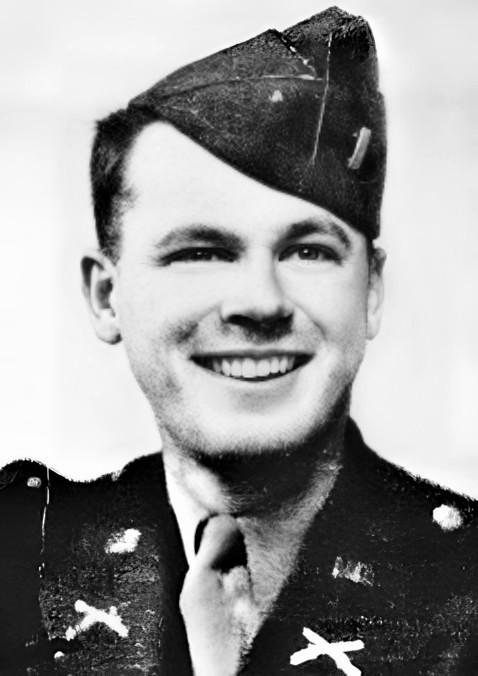
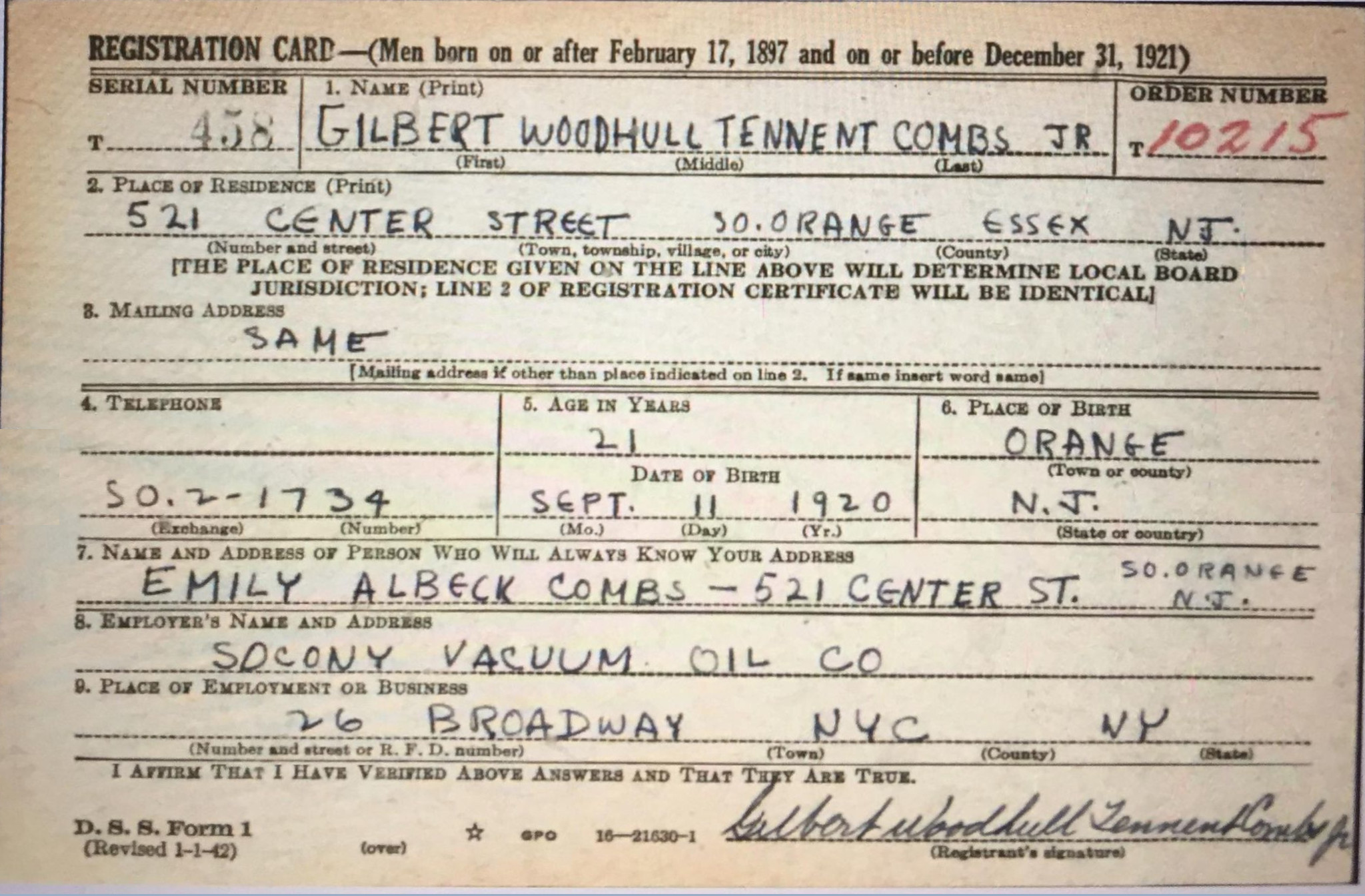
Gilbert Woodhull Tennent COMBS Jr
| ||||||||||||||||||||||||||||||
|---|---|---|---|---|---|---|---|---|---|---|---|---|---|---|---|---|---|---|---|---|---|---|---|---|---|---|---|---|---|---|
|
Source : Arnaud Gaté (Ellen Marchese) | ||||||||||||||||||||||||||||||
| NUMBER OF SERVICE | O-1310222 (32388871) | |||||||||||||||||||||||||||||
| AGE | 24 yo | |||||||||||||||||||||||||||||
| DATE OF BIRTH | 11 October 1920 | |||||||||||||||||||||||||||||
| ENLISTMENT STATE | NEW JERSEY | |||||||||||||||||||||||||||||
| FAMILY | Single | |||||||||||||||||||||||||||||
| RANK | Second Lieutenant | |||||||||||||||||||||||||||||
| FONCTION | Tankiste | |||||||||||||||||||||||||||||
| JOB BEFORE ENLISTEMENT | General industry clerks |  | ||||||||||||||||||||||||||||
| DATE of ENLISTEMENT | 6 July 1942 Newark NEW JERSEY | |||||||||||||||||||||||||||||
| COMPANY | Company | |||||||||||||||||||||||||||||
| REGIMENT | 41st Armored Infantry Regiment | |||||||||||||||||||||||||||||
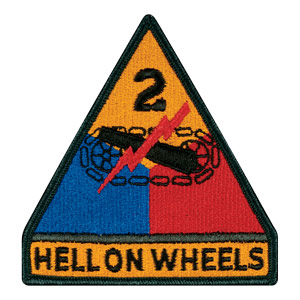
| DIVISION | 2nd Armored Division | |||||||||||||||||||||||||||||
| DATE OF DEATH | 3 July 1944 |
Source : F Lavernhe | ||||||||||||||||||||||||||||
| STATUS | KIA | |||||||||||||||||||||||||||||
| PLACE OF DEATH | ||||||||||||||||||||||||||||||
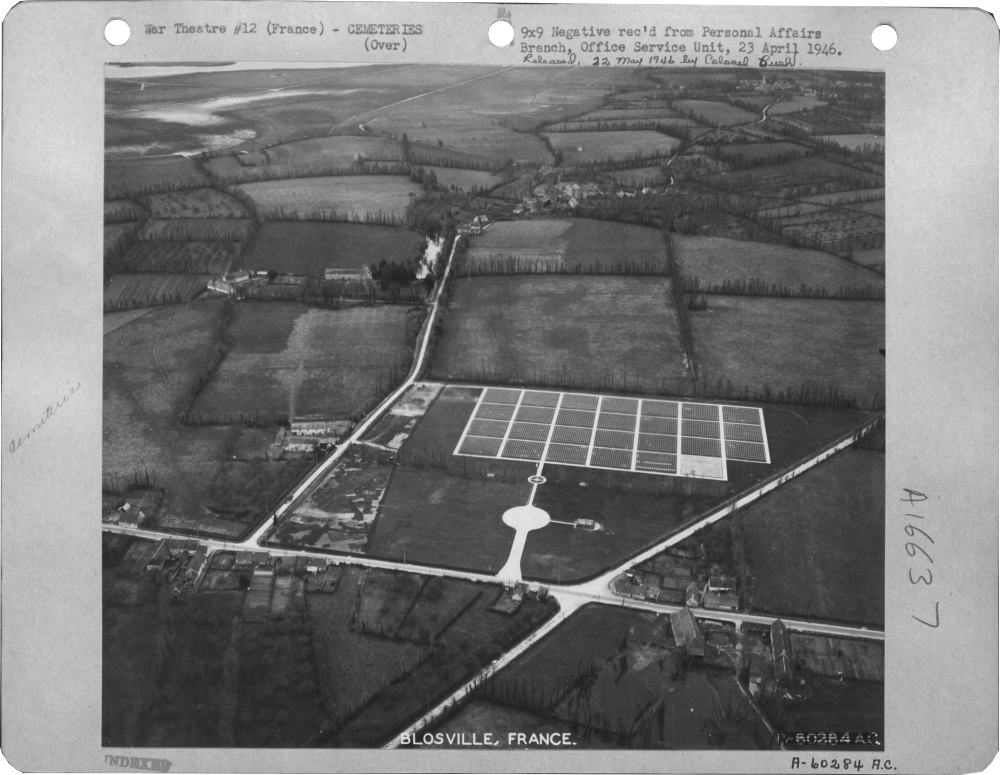
| CEMETERY TEMPORARY |
CEMTERY TEMPORARY of Blosville N°3508
| |||||||||||||||||||||||||||||
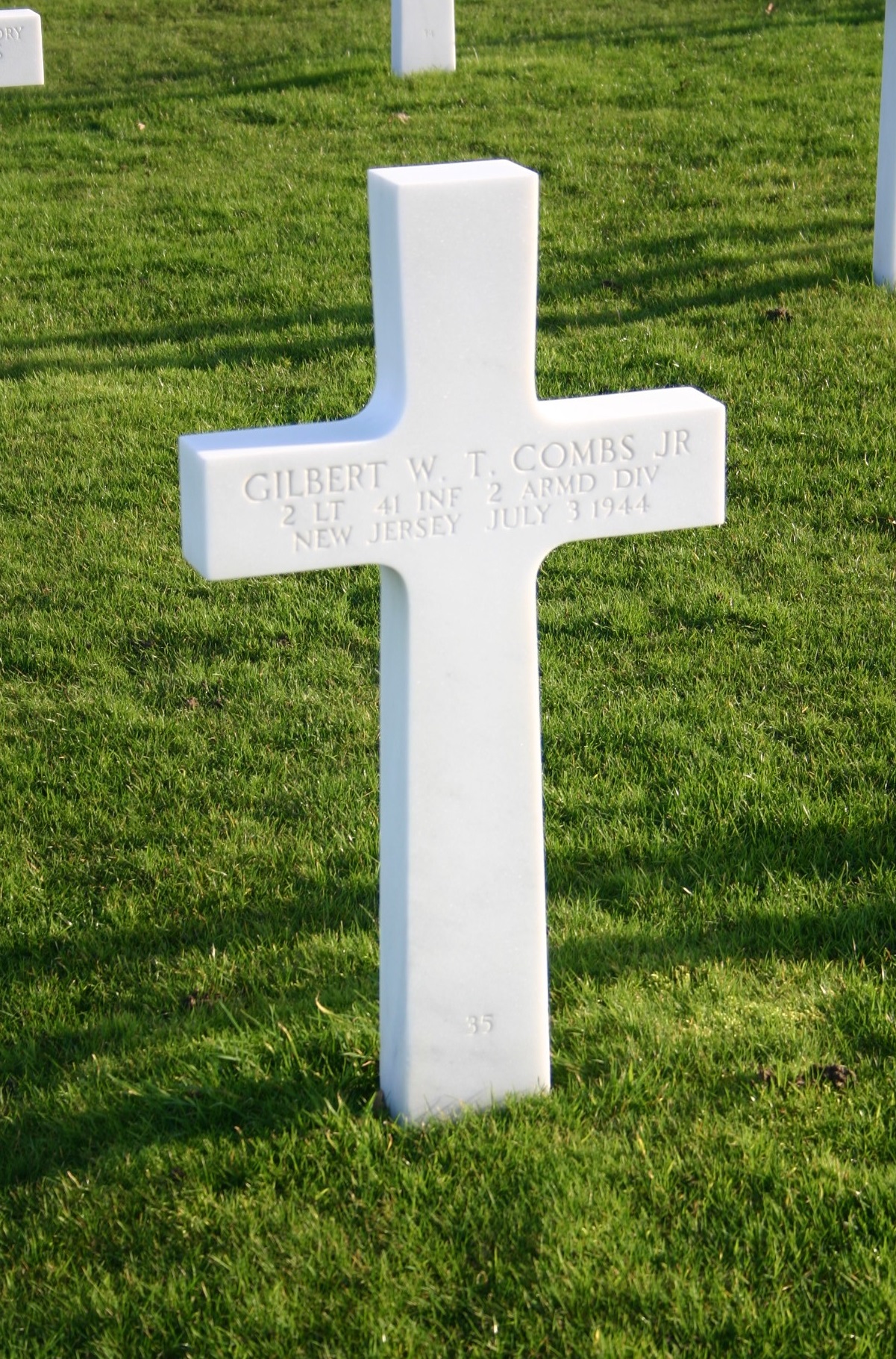
| CEMETERY | NORMANDY AMERICAN CEMETERY of Colleville | |||||||||||||||||||||||||||||
| GRAVE |
| |||||||||||||||||||||||||||||
| DECORATION |
| |||||||||||||||||||||||||||||
|
On July 3, 1944, Combs’s unit was headed towards Saint-Lô. Combs volunteered to command a reconnaissance patrol to determine the location and strength of German troops. The patrol faced enemy fire and Second Lieutenant Combs ordered his men to retreat. As hee returned to the line of fire to administer aid to one of his fatally wounded soldiers, Combs was shot and killed. For his heroic actions, he was awarded a Silver Star. | 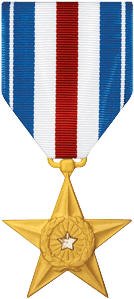 | |||||||||||||||||||||||||||||
|
| STORY | ||||||||||||||||||||||||||||||
Early LifeGilbert Woodhull Tennent Combs, Jr. was born on September 11, 1920. His family lived 521 Centre Street, South Orange, New Jersey. The house was built in 1895 by Thomas Kingman, a real estate investor and developer who helped establish Montrose Park Historic District. Originally, Kingman’s wife, Anna, was listed as the owner of the house, but Gilbert’s father, Gilbert W. T. Combs Sr., bought the property in 1896.
| ||||||||||||||||||||||||||||||
|
Source : Monty McDaniel | ||||||||||||||||||||||||||||||
|
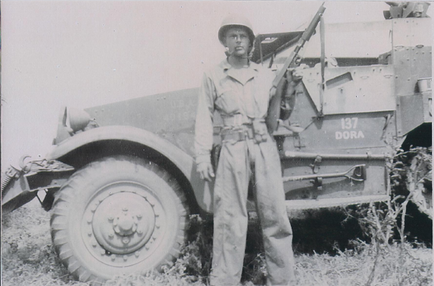
Second Lieutenant Gilbert Woodhull Tennent Combs, Jr. standing in front of a Jeep Willy. Courtesy of the Gilbert Family. Source : Nhdsilentheroes.org |
HomefrontNew Jersey’s PartAlmost 500,000 New Jersey residents served in World War II, more than 10 percent of the state’s population. New York ShipbuildingNew York Shipbuilding was once the world’s largest shipbuilders, located in Camden, New Jersey. During the 1940s, the company was the world’s largest private shipbuilding facility. During the war, it employed more than 35,000 people. They built the battleship South Dakota, 12-inch gun cruisers Alaska and Hawai’i, numerous heavy and light cruisers, light aircraft carriers, and 148 landing craft. | |||||||||||||||||||||||||||||
Camp KilmerIn late 1941, the U.S. War Department purchased land for Camp Kilmer, a 1,500-acre stretch of land between Edison and Piscataway, New Jersey. The camp was named in honor of Joyce Kilmer, a poet who gave his life serving in World War I. Construction on Camp Kilmer began in January 1942 and completed by the summer. The camp consisted of 1,120 buildings, including barracks, seven chapels, five theatres, a gym, four telephone centers, nine post exchanges, a post office, a 1,000 bed hospital, 28 miles of road, and 11 railheads that connected to one main line. Camp Kilmer served as a major soldier transportation hub during World War II, becoming the home of 1,300,000 soldiers before they deployed to the European Theatre of Operation (ETO). Camp Kilmer offered 20 softball diamonds, 30 volleyball courts, and 160 horseshoe courts for soldiers to use while stationed there. Once World War II was over, Camp Kilmer played a new role as a receiving center for soldiers returning from the European Theatre of Operation (ETO) and Pacific Theatre of Operation (PTO). By September 1945, 300,000 men had returned through Camp Kilmer and by December of the same year, 1,000,000 men had returned through the camp. Camp Kilmer was activated again during the Korean War, but by that time Fort Dix had become the major transportation hub of New Jersey. Camp Kilmer’s final job included receiving people during the Hungarian Revolution. Battery 223, Cape MayAs part of the 1940 Harbor Defense Program, Battery 223 was built by the U.S. Army Corps of Engineers in Cape May, New Jersey to protect the East Coast. Naval gunnery crews stationed inside the bunker scanned the surrounding area for enemy ships and submarines. Built in 1942, the original building structure still stands today, but more than 70 years of beach erosion has placed the bunker directly on the sand. Also, the wooden support pilings underneath the ground now protrude from the sand, making the structure look massive and ready to topple over at any moment. The bunker was equipped with six-inch turret guns on its sides for lateral protection. Facing the Atlantic Ocean and the Delaware Bay, the front of the bunker had Panama mounts with 4 155mm coast artillery guns. Across the Delaware Bay, bunker 223 had a sister bunker. The Jacob Jones, the first warship sunk by enemy action after the attack on Pearl Harbor, was sunk only 35 miles off the coast of Cape May. In addition, after Germany surrendered, the first German U-boat surrendered only 100 miles off the coast of Cape May. Both events show that German submarines were active off the coast of New Jersey, justifying the need for coastal defense systems such as Bunker 223. In June 2008, Battery 223 received landmark status and is listed on the National Register of Historic Places. “America’s First Defense Airport”The Millville Army Airfield was dedicated as America’s First Defense Airport on August 2, 1941. By January 1943, construction was complete and it opened as a gunnery school teaching most pilots to fly the Republic P-47 Thunderbolt. Overall, the Millville Army Airfield operated for three years and awarded about 1,500 pilots advanced fighter training in the P-47. After World War II ended, America’s First Defense Airport was deemed unnecessary and converted into apartments for many returning veterans of war.
Military ExperienceCombs was commissioned a second lieutenant assigned to the 2nd Armored Division, 41st Infantry Regiment.. Like many others, Combs participated in the D-Day Invasion at Utah Beach, working to free France from Nazi Germany Utah BeachOn June 6, 1944, Stalin’s request for the Allies to open up a second front was granted. The Allied forces planned and executed Operation Overlord, the invasion of Normandy. Overall, Utah Beach was an extremely successful operation. Over 23,000 troops landed on Utah Beach with 1,700 vehicles with only about 200 casualties. Combs survived the invasion of Utah Beach and continued to fight for the American forces moving inland as part of the Invasion of Normandy. On July 3, 1944, Combs’s unit was headed towards Saint-Lô. Combs volunteered to command a reconnaissance patrol to determine the location and strength of German troops. The patrol faced enemy fire and Second Lieutenant Combs ordered his men to retreat. As hee returned to the line of fire to administer aid to one of his fatally wounded soldiers, Combs was shot and killed. For his heroic actions, he was awarded a Silver Star. EulogyToday, Gilbert Woodhull Tennent Combs, Jr. rests at Normandy American Cemetery. The cemetery overlooks Omaha Beach and the English Channel, providing breathtaking views for all to visit. He was a man who chose to leave his ordinary life in the comforts of a well-to-do family, to preserve American freedoms when they were most at risk during the Second World War. His life initially seemed uneventful, but suddenly, after deciding to walk into the Newark, New Jersey office for the United States Army and enlist for World War II, Combs’ story became remarkable. Enlisting for World War II was only the first of many extraordinary decisions that he made. Combs died the way he lived: continually sacrificing his own safety in hope that those around him were better off. This is a simple phrase, yet it speaks so vastly about the choices that made up the character of Gilbert Woodhull Tennent Combs, Jr. | ||||||||||||||||||||||||||||||






Activated/Activé |
Normandy/Normandie |
| 15 Jul 1940 | Days of Combat/Jour de Combat 443 |
| Casualties/Victimes 20 659 | |
Entered Combat/Entré au combat |
|
| 8 Nov 1942 | |
|
Commanding Generals/Commandants généraux Maj. Gen. Charles L. Scott (Jul 40 - Jan 41) |
Campaigns/CampagnesAlgeria-French Morocco (8 Nov 42 - 11 Nov 42) |
CARTES DE CAMPAGNE DE LA 2e DIVISION BLINDÉE - CAMPAIGN MAPS OF THE 2nd ARMORED DIVISION |
|
 |
|
|
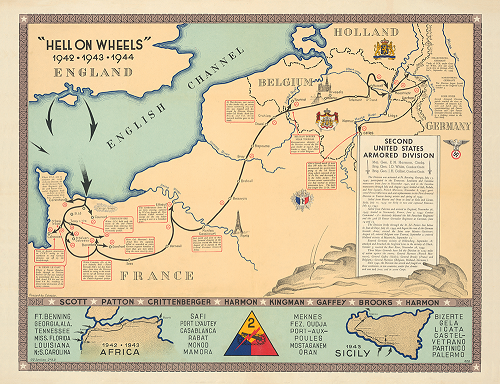
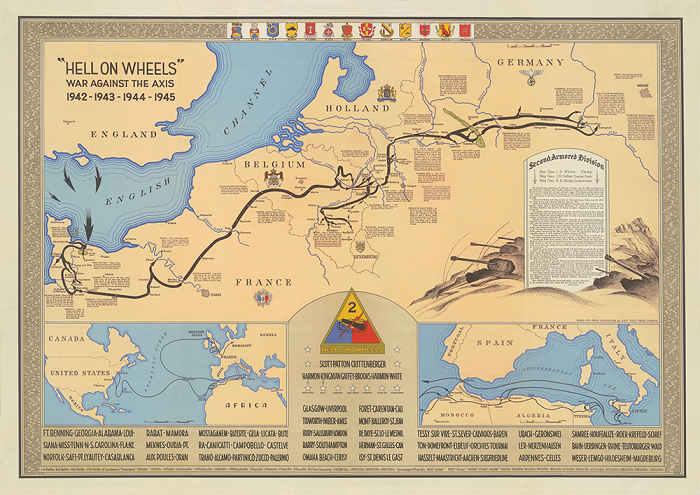
These vintage maps chart the journey of the 2nd Armored Division throughout Europe during World War II. The top map covers the years 1942 to 1944. The bottom map includes 1945. Ces cartes d'époque illustrent le parcours de la 2e division blindée à travers l'Europe pendant la Seconde Guerre mondiale. La carte du haut couvre les années 1942 à 1944. La carte du bas comprend 1945.
|
|
 |
|
DIVISION CHRONICLEElements of the Division first saw action in North Africa, landing at Casablanca, 8 November 1942, and later taking part in the fighting at Beja, Tunisia, but the Division as a whole did not enter combat until the invasion of Sicily, when it made an assault landing at Gela, 10 July 1943. The Division saw action at Butera, Campobello,-and Palermo. After the Sicilian campaign, the Division trained in England for the cross-Channel invasion, landed in Normandy D plus 3, 9 June 1944, and went into action in the vicinity of Carentan; ; the Division raced across France in July and August, drove through Belgium and attacked across the Albert Canal 13 September 1944, crossing the German border at Schimmert, 18 September to take up defensive positions near Geilenkirchen. On 3 October, the Division launched an attack on the Siegfried Line from Marienberg, broke through, crossed the Wurm River and seized Puffendorf 16 November and Barmen 28 November. The Division was holding positions on the Roer when it was ordered to help contain the German Ardennes offensive. The Division fought in eastern Belgium, blunting the German Fifth Panzer Army's penetration of American lines. The Division helped reduce the Bulge in January, fighting in the Ardennes forest in deep snow, and cleared the area from Houffalize to the Ourthe River of the enemy. After a rest in February, the Division drove on across the Rhine 27 March, and was the first American Division to reach the Elbe at Schonebeck on 11 April. It was halted on the Elbe, 20 April, on orders. In July the Division entered Berlin-the first American unit to enter the German capital city. |
CHRONIQUE DE DIVISIONDes éléments de la division ont d'abord été déployés en Afrique du Nord, atterrissant à Casablanca le 8 novembre 1942, puis ont pris part aux combats à Beja, en Tunisie, mais la division dans son ensemble n'a pas envahi la Sicile. un assaut atterrissant à Gela, le 10 juillet 1943. La division a été attaquée à Butera, Campobello et Palerme. Après la campagne sicilienne, la division s’est entraînée en Angleterre pour l’invasion transmanche, a atterri en Normandie D plus 3, le 9 juin 1944, et s’est engagée dans les environs de Carentan; ; La Division a traversé la France en juillet et août, a traversé la Belgique le 13 septembre 1944 et a franchi la frontière allemande à Schimmert le 18 septembre pour traverser le canal Albert afin de prendre des positions défensives près de Geilenkirchen. Le 3 octobre, la division a lancé une attaque sur la ligne Siegfried au départ de Marienberg, a franchi la rivière Wurm et a saisi Puffendorf le 16 novembre et Barmen le 28 novembre. La division tenait des positions sur le Roer quand il a été ordonné d'aider à contenir l'offensive des Ardennes allemandes. La division a combattu dans l'est de la Belgique, brisant la pénétration des lignes américaines par la cinquième armée panzer allemande. La division a aidé à réduire les Ardennes en janvier, se battant dans la forêt des Ardennes dans la neige profonde, et a dégagé la zone de Houffalize à la rivière Ourthe de l'ennemi. Après un repos en février, la division a traversé le Rhin le 27 mars et a été la première division américaine à atteindre l’Elbe à Schonebeck le 11 avril. Il a été arrêté sur l'Elbe, le 20 avril, sur ordre. En juillet, la division est entrée dans Berlin, la première unité américaine à entrer dans la capitale allemande. |
| SOURCE INFORMATION & PHOTO | Armydivs.squarespace.com |
|---|
| SOURCE INFORMATION & SOURCE PHOTO | Monty McDaniel - Aad.archives.gov - Abmc.gov - Findagrave.com - Thierry Leothier |
|---|---|
| PROGRAMMER | Henri, Garrett, Clive, Frédéric & Renaud |