


|
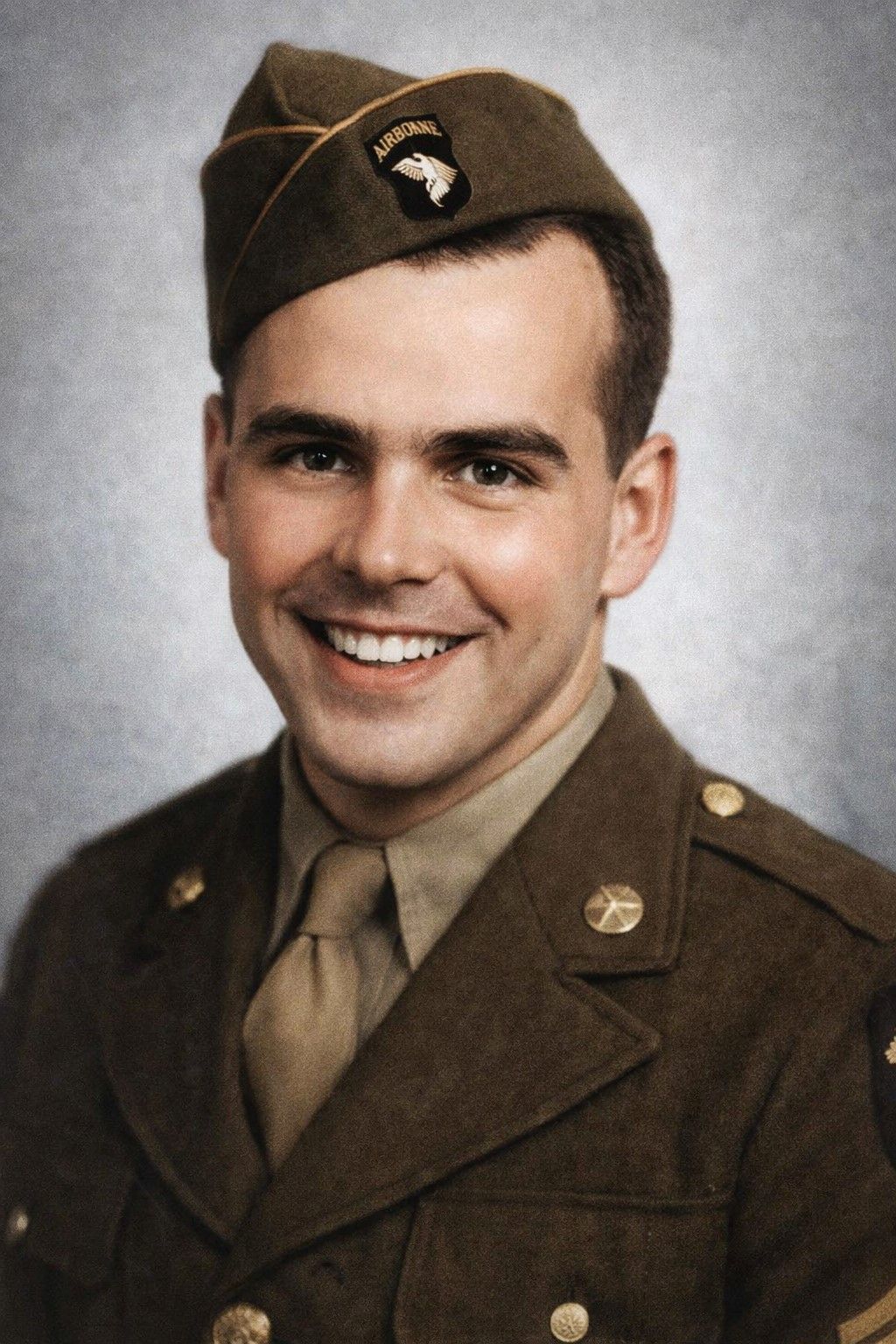
Donald Paul CLEARY
| ||||||||||||||||||||||||||||
|---|---|---|---|---|---|---|---|---|---|---|---|---|---|---|---|---|---|---|---|---|---|---|---|---|---|---|---|---|
|
Source : Lakegirl | ||||||||||||||||||||||||||||
| NUMBER OF SERVICE | 16062339 | |||||||||||||||||||||||||||
| AGE | 22 | |||||||||||||||||||||||||||
| DATE OF BIRTH | 1922 MICHIGAN | |||||||||||||||||||||||||||
| ENLISTMENT STATE | MICHIGAN | |||||||||||||||||||||||||||
| FAMILY |
Spouse : Bernadette Theresa NABB Parents : Patrick J & Ruth A Ward CLEARY | |||||||||||||||||||||||||||
| RANK |
| |||||||||||||||||||||||||||
| FONCTION | Paratroopers | |||||||||||||||||||||||||||
| JOB BEFORE ENLISTEMENT | Clerks, general office |  | ||||||||||||||||||||||||||
| DATE of ENLISTEMENT | 17 February 1942 Detroit, MICHIGAN | |||||||||||||||||||||||||||
| COMPANY | Company SVC | |||||||||||||||||||||||||||
| BATTALION | ||||||||||||||||||||||||||||
| REGIMENT | 507th Parachute Infantry Regiment | |||||||||||||||||||||||||||
| DIVISION | 82nd Airborne Division | |||||||||||||||||||||||||||
| DATE OF DEATH | 7 June 1944 |
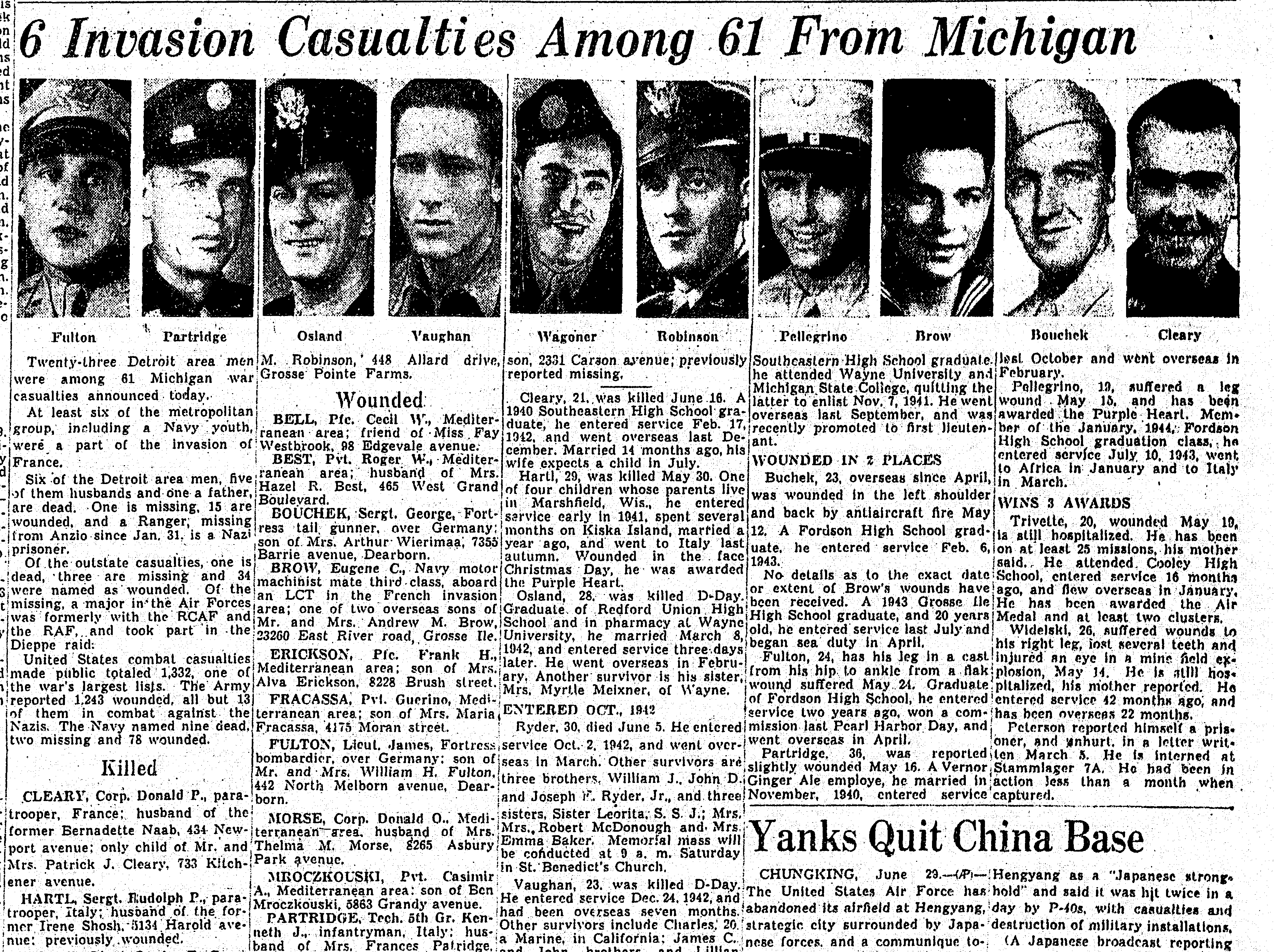
Source : F Lavernhe | ||||||||||||||||||||||||||
| STATUS | KIA | |||||||||||||||||||||||||||
| PLACE OF DEATH | ||||||||||||||||||||||||||||
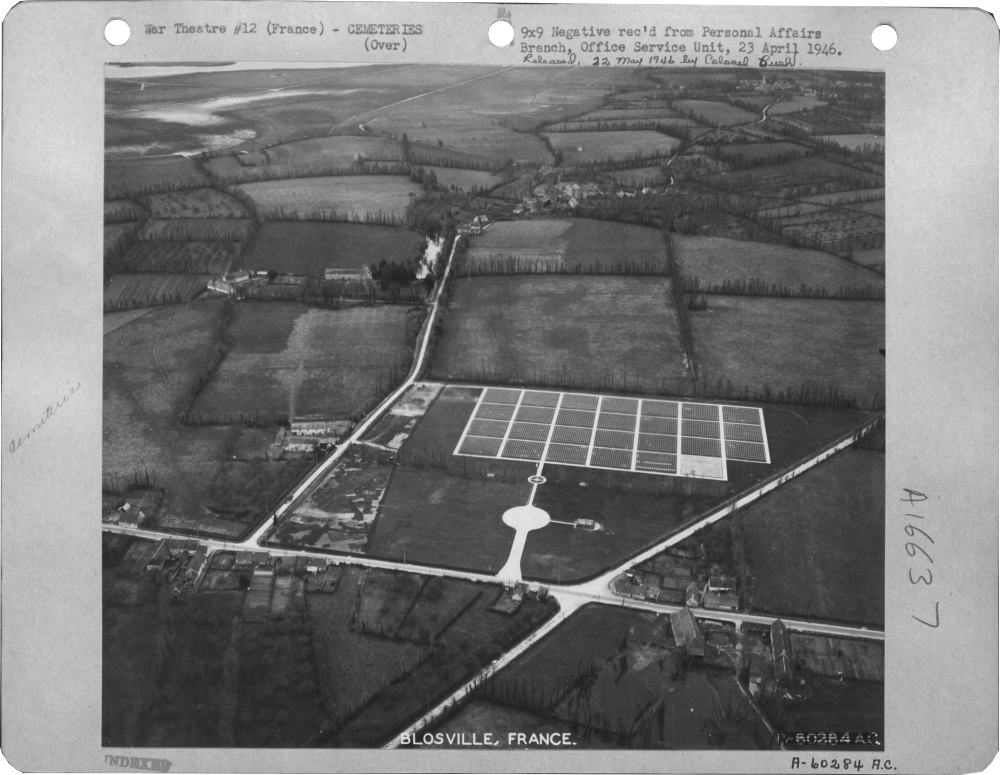
| CEMETERY TEMPORARY |
CEMETERY TEMPORARY of Blosville N°3508
| |||||||||||||||||||||||||||
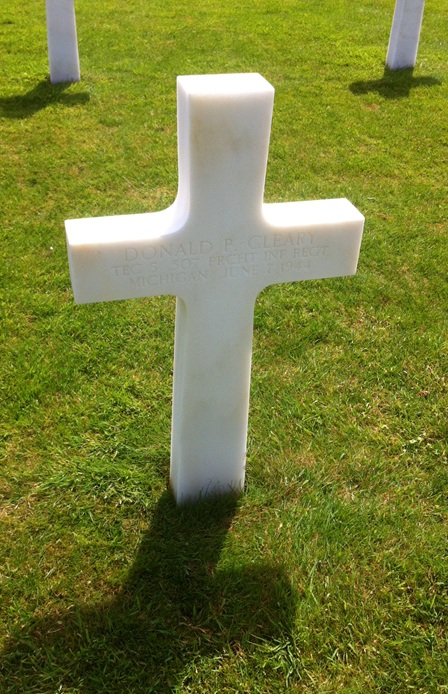
| CEMETERY | NORMANDY AMERICAN CEMETERY of Colleville | |||||||||||||||||||||||||||
| GRAVE |
| |||||||||||||||||||||||||||
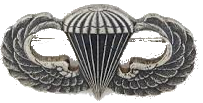
| DECORATION & BADGE |
| |||||||||||||||||||||||||||
| ||||||||||||||||||||||||||||
| STORY | ||||||||||||||||||||||||||||
|
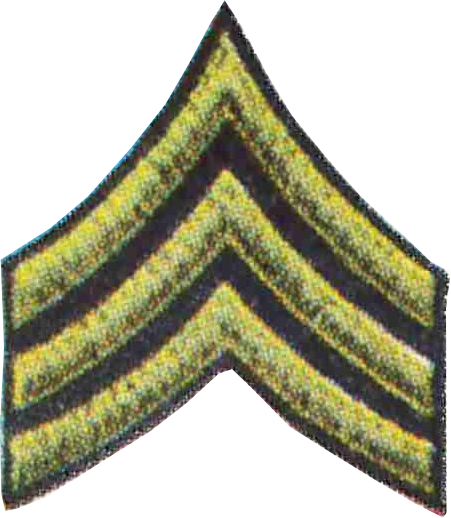
Donald Paul Cleary was born in 1922 in the State of Michigan. No records on his date of birth, his parents’ names or information on his early life could be found. Donald enlisted into the U.S. Army on 17 February 1942 at Detroit, Michigan. His enlistment record indicated that he was single, had 1 year of high school and was employed as a general office clerk. After basic training, he volunteered to join the paratroopers. Upon completing paratrooper training at Fort Benning in Georgia, he received his Wings and Boots and was sent to the 507th Parachute Infantry Regiment. During his training period Donald married Bernadette Theresa Nabb in Detroit, Michigan in May 1943. Based on his enlistment date it is assumed that T/5 Cleary arrived in Europe at the end of December 1943, to train for the D-Day invasion. It is not known when T/5 Cleary received his promotion to Technician Grade Five, a specialized enlisted rank with the equivalent rank of Corporal. It is also not known what special skill or service Cleary achieved to be promoted to this rank. During the early hours of June 6, 1944, three battalions of paratroopers (approximately 2,000 men) assigned to the 82nd Airborne, 507th Parachute Infantry Regiment departed from Fulbeck and Barkston Heath Airfields in England for a two-hour flight to Drop Zone T which was located behind the Utah Beach landing area. Drop Zone T was an area located between the village of AmFreville and the west bank Merderet River in the vicinity of the Village of Sainte- Mere-Eglise on the Cotentin Peninsula France. The 1st battalion consisting of over 750 paratroopers and headquarters personnel departed on forty-five aircraft from Fulbeck Airfield and the 2nd and 3rd battalions consisting of 1,230 paratroopers departed on seventy-two aircraft from Barkston Heath Airfield. Pilots and crews from the 61st Troop Carrier Group were responsible for transporting the 507th PIR on 117 C-47 aircraft to their designated Drop Zone. On the evening of 5 June 1944, T/5 Cleary was a member of 82nd Airborne Division, 507th Parachute Infantry Regiment, SVC, when he boarded a C-47 (Sky Train) plane number 43-15124 and departed from Fulbeck Airfield. The stated objective for his Company was to assist in sizing, clearing, and securing bridges on the Merderet River near the Village of AmFreville,. Unfortunately, the paratroopers in the 507th PIR had the longest flight time of any paratroop regiment on that faithful morning, taking a little over two hours to reach their drop zones. This distance along with cloudy weather conditions and the general fog of war caused the paratroopers to land in an area spread out over 100 kilometers (60 miles) around their intended Drop Zone. A large number of paratroopers landed in the general area between the Villages of AmFreville, La Fiere, Sainte-Mere-Eglise and Le Ham in the Cotentin Peninsula. Throughout the early morning hours of 6 June 1944, the paratroopers, dazed and battered, formed fighting units, and went about their stated mission. T/5 Cleary successfully jumped into France on 6 June 1944 and was killed in action in France, on 7 June 1944. T/5 Donald Paul Cleary was initially buried at a temporary military cemetery in France. After the war he was reinterred at Normandy American Cemetery and Memorial in Colleville-sur-Mer, Normandie, France. Thank you, T/5 Cleary, for your service and your sacrifice, you will not be forgotten. By : emalin995 (Fold3) | ||||||||||||||||||||||||||||
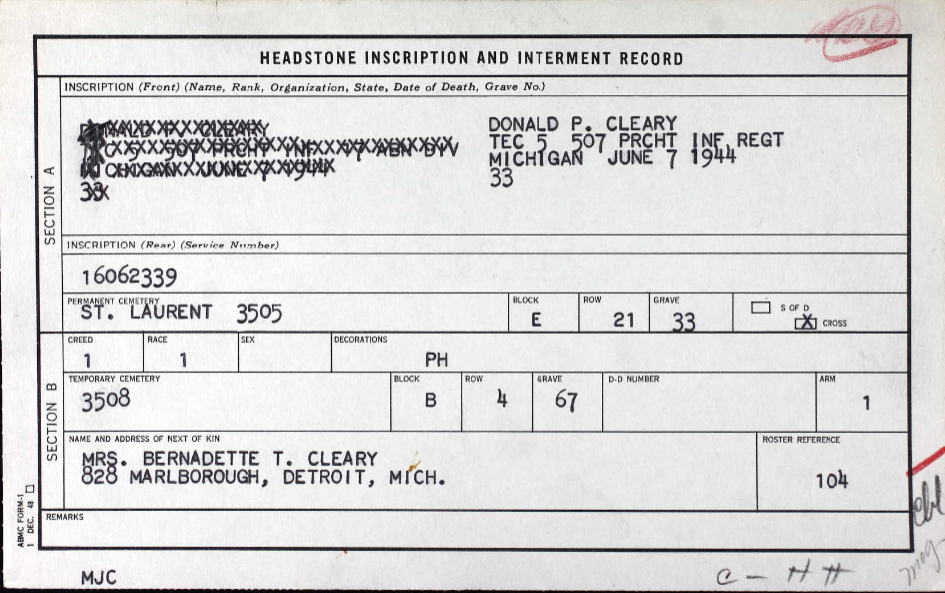
Source : Ancestry | ||||||||||||||||||||||||||||
|
Source : Lakegirl | ||||||||||||||||||||||||||||








Activated/Activé |
Normandy/Normandie |
| 25 Mar 1942 | Days of Combat/Jour de Combat 422 |
| Casualties/Victimes 9 073 | |
Entered Combat/Entré au combat |
|
| 9 Jul 1943 at Sicily | |
|
Commanding Generals/Commandants généraux Maj. Gen. Omar Bradley (Mar 42 - Jun 42) |
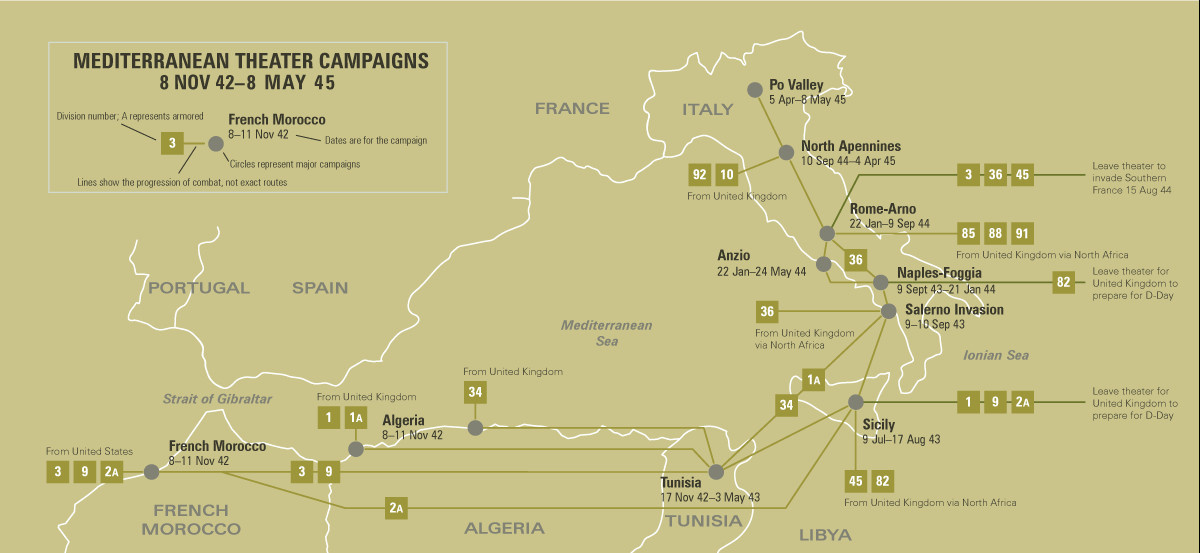
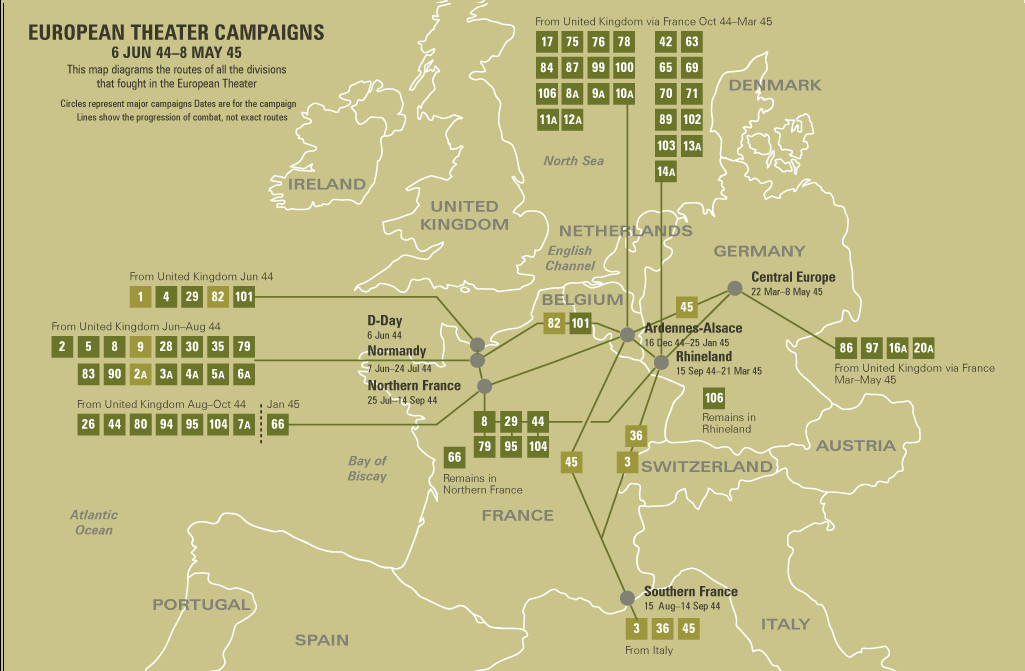
Campaigns/CampagnesSicily (9 Jul - 17 Aug 43) Normandy (6 Jun 44 - 24 Jul 44) Rhineland (15 Sep 44 - 21 Mar 45) |
CARTE DE CAMPAGNE DU THÉÂTRE MÉDITERRANÉENCAMPAIGN MAP OF THE MEDITERRANEAN THEATER |
|
 |
|
PLAN DE ROUTE DE LA CAMPAGNE - CAMPAIGN ROUTE MAP |
|
 |
|
DIVISION CHRONICLEThe 82d Airborne Division landed at Casablanca, 10 May 1943, and trained. Elements first saw combat in Sicily, when the 505th RCT and part of the 504th dropped behind enemy lines, 9-10 July 1943, at Gela. The remainder of the 504th RCT dropped, 11-12 July 1943, also near Gela, after running friendly naval and ground force fire. Scattered elements formed and fought as ground troops. The elements were flown back to Tunisia for reequipment and returned to Sicily to take off for drop landings on the Salerno beachhead. The 504th Parachute Infantry dropped, 13 September 1943, and the 505th the following night; the 325th landed by boat. These elements bolstered Salerno defenses and fought their way into Naples, 1 October 1943. After a period of occupation duty (and combat for some elements in the Volturno Valley and Anzio beachhead), the Division moved to Ireland, November 1943, and later to England, February 1944, for additional training. Moving in by glider and parachute, troops of the 82d dropped behind enemy lines in Normandy on D-day, 6 June 1944, before ground troops hit the beaches. Cutting off enemy reinforcements, the Division fought its way from Carentan to St. Sauveur-le-Vicomte, fighting 33 days without relief. Relieved on 8 July, it returned to England for refitting. On 17 September, it was dropped at Nijmegen, 50 miles behind enemy lines, and captured the Nijmegen bridge, 20 September, permitting relief of British paratroops by the British 2d Army. After heavy fighting in Holland, the Division was relieved 11 November and rested in France. It was returned to combat, 18 December 1944, to stem the von Rundstedt offensive, blunting the northern salient of the Bulge. It punched through the Siegfried Line in early February 1945, and crossed the Roer, 17 February. Training with new equipment in March, the Division returned to combat, 4 April, patrolling along the Rhine, securing the Koln area, later moving across the Elbe, 30 April, into the Mecklenburg Plain, where, 2 May 1945, the German 21st Army surrendered. |
CHRONIQUE DE DIVISIONLa 82ème division aéroportée a atterri à Casablanca le 10 mai 1943 et s'est entraînée. Les éléments ont d'abord été combattus en Sicile, lorsque le 505ème RCT et une partie du 504ème ont été largués derrière les lignes ennemies, du 9 au 10 juillet 1943, à Gela. Le reste de la 504ème RCT est tombé, du 11 au 12 juillet 1943, également près de Gela, après des tirs amicaux contre des forces navales et terrestres. Des éléments épars se sont formés et se sont battus en tant que troupes au sol. Les éléments ont été rapatriés en Tunisie pour le rééquipement et sont retournés en Sicile pour décoller pour atterrir sur la tête de pont de Salerne. Le 504th Infantry Parachute Infantry est tombé le 13 septembre 1943 et le 505ème le lendemain soir; la 325ème atterrit en bateau. Ces éléments ont renforcé les défenses de Salerno et se sont introduits à Naples, le 1er octobre 1943. Après une période d'occupation (et de combat pour certains éléments dans la vallée de Volturno et la tête de pont d'Anzio), la division s'est installée en Irlande en novembre 1943 , Février 1944, pour une formation supplémentaire. Se déplaçant en planeur et en parachute, les troupes du 82d tombèrent derrière les lignes ennemies en Normandie le 6 juin 1944, avant que les troupes terrestres ne frappent les plages. En coupant les renforts ennemis, la Division se fraya un chemin de Carentan à Saint-Sauveur-le-Vicomte, combattant 33 jours sans soulagement. Soulagé le 8 juillet, il est retourné en Angleterre pour y être réaménagé. Le 17 septembre, il a été largué à Nimègue, à 50 milles derrière les lignes ennemies, et a capturé le pont de Nimègue, le 20 septembre, permettant ainsi à la 2 e armée britannique de soulager les parachutistes britanniques. Après de violents combats en Hollande, la division est soulagée le 11 novembre et se repose en France. Il fut remis au combat le 18 décembre 1944 pour endiguer l’offensive de von Rundstedt, assourdissant le saillant septentrional des Ardennes. Il a percuté la ligne Siegfried au début de février 1945 et a traversé la Roer le 17 février. S'entraînant avec de nouveaux équipements en mars, la Division est revenue au combat le 4 avril, patrouillant le long du Rhin, sécurisant la région de Koln, traversant ensuite l'Elbe le 30 avril dans la plaine de Mecklenburg où, le 2 mai 1945 s'est rendu. |
| SOURCE INFORMATION & PHOTO | Armydivs.squarespace.com |
|---|
| SOURCE INFORMATION & SOURCE PHOTO | Arnaud Gaté - Abmc.gov - Findagrave.com - Ancestry |
|---|---|
| EDITORS | Victor, Jean-Philippe, Eric, Henri, Garrett, Clive, Frédéric & Renaud |