


|
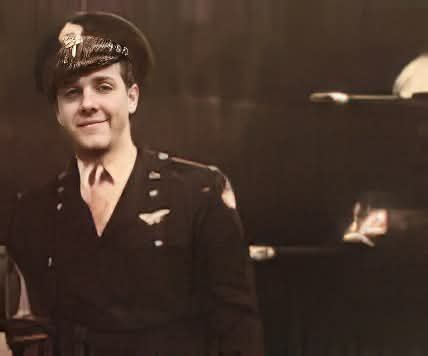
Axel Peter SLUSTROP
“Pete”
| ||||||
|---|---|---|---|---|---|---|
|
Source : Frogman (Ellen Marchese) | ||||||
| NUMBER OF SERVICE | O-738483 | |||||
| AGE | 22 yo | |||||
| DATE OF BIRTH | 5 February 1922 Portland, Multnomah County, OREGON | |||||
| ENLISTMENT STATE | OREGON | |||||
| FAMILY |
Parents : Peter & Karen Olsen SLUSTROP Sister : Alfreda Ruth Olsen | |||||
| RANK |
| |||||
| FONCTION | Co Pilot | |||||
| JOB BEFORE ENLISTEMENT | Employee at Austin Construction Co |  | ||||
| DATE of ENLISTEMENT | 12 March 1942 | |||||
| REGIMENT SQUADRON | 555th Bomber Squadron | |||||
| DIVISION GROUP | 386th Bomber Group, Medium | |||||
| ARMY | 9th Air Force | |||||
| DATE OF DEATH | 22 June 1944 |
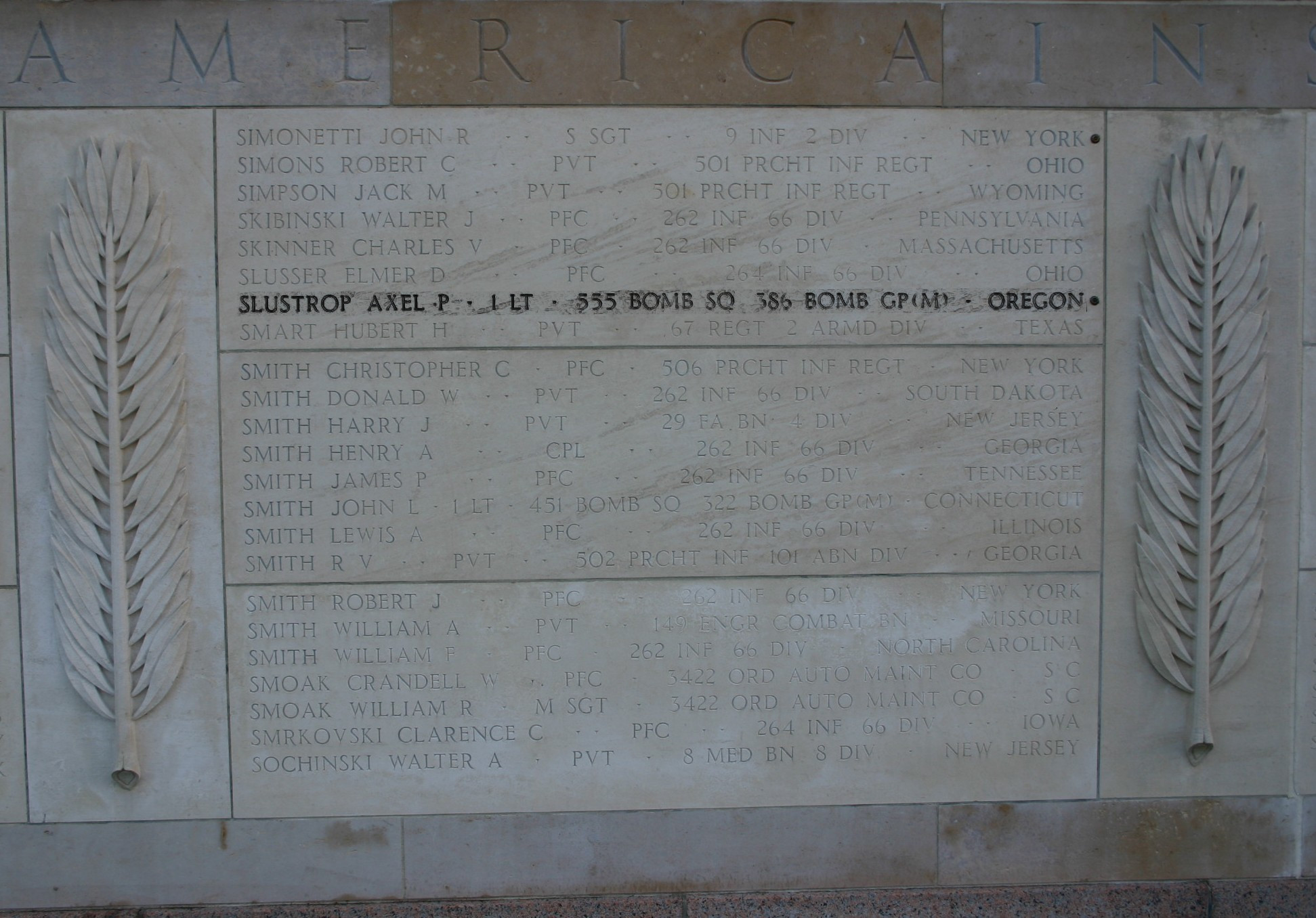
Normandy American Cemetery and Memorial Source : F Lavernhe
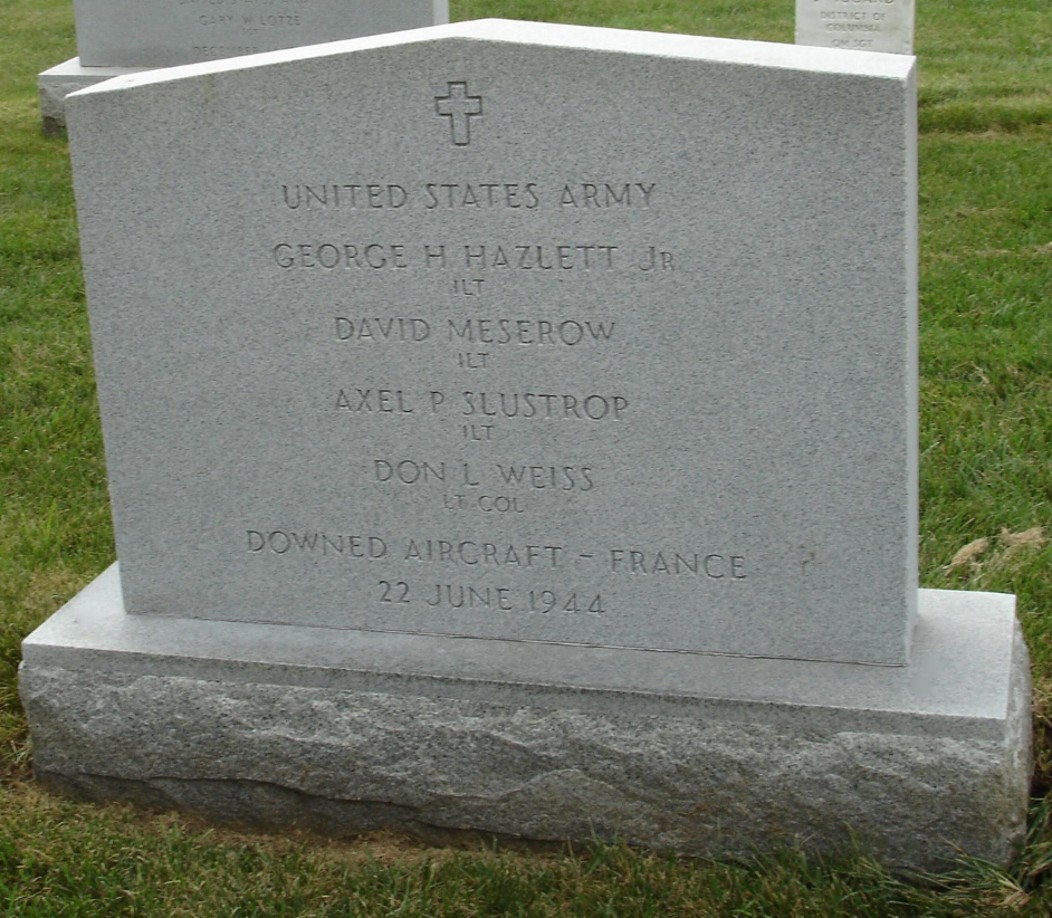
Arlington National Cemetery Source : Hope | ||||
| STATUS | KIA | |||||
| PLACE OF DEATH | Baron sur odon | |||||
| PLAN DE VOL / FLIGHT PLAN |
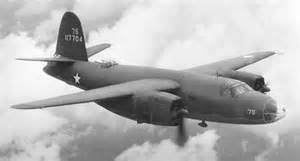
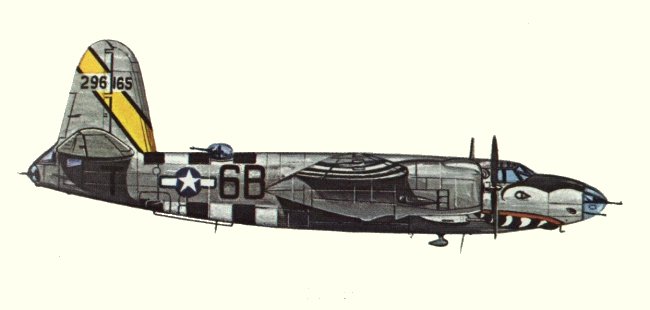
B-26 Marauder - type B-55-MA - s/n 42-96087 YA*O
Macr : 6283 Mission: German HQ in Caen Station de décollage 164 Great Dunmow, Essex Shot by the flak Explosion in flight | |||||
| CEMETERY | NORMANDY AMERICAN CEMETERY of Colleville | |||||
| GRAVE |
| |||||
|
1LT Slustrop was originally listed as missing in action or non-recoverable. His name was permanently inscribed on the Tablets of the Missing at the Normandy American Cemetery. 1LT Slustrop's remains were recovered, identified and permanently interred at Arlington National Cemetery.

When an individual’s remains have been accounted for by the U.S. Department of Defense, a rosette is placed next to the name on the Wall/Tablet/Court of the Missing to mark that the person now rests in a known gravesite.
| ||||||
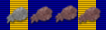
| DECORATION |
| |||||
| ||||||
| STORY | ||||||
|
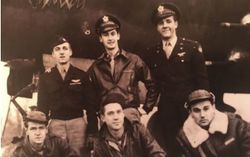
Top row, from left: Lt. Col. Don Weiss, Lt. David Meserow, Lt. Axel Slustrop. Bottom row: Staff Sgt. John H. Canty,, S/Sgt. Tom McCaslin, T/Sgt. Clement Monaco. All but Monaco were aboard the B-26 when it was shot down. Source : Frogman | ||||||
|
Source : lwiesenfelder764 (Fold3) |
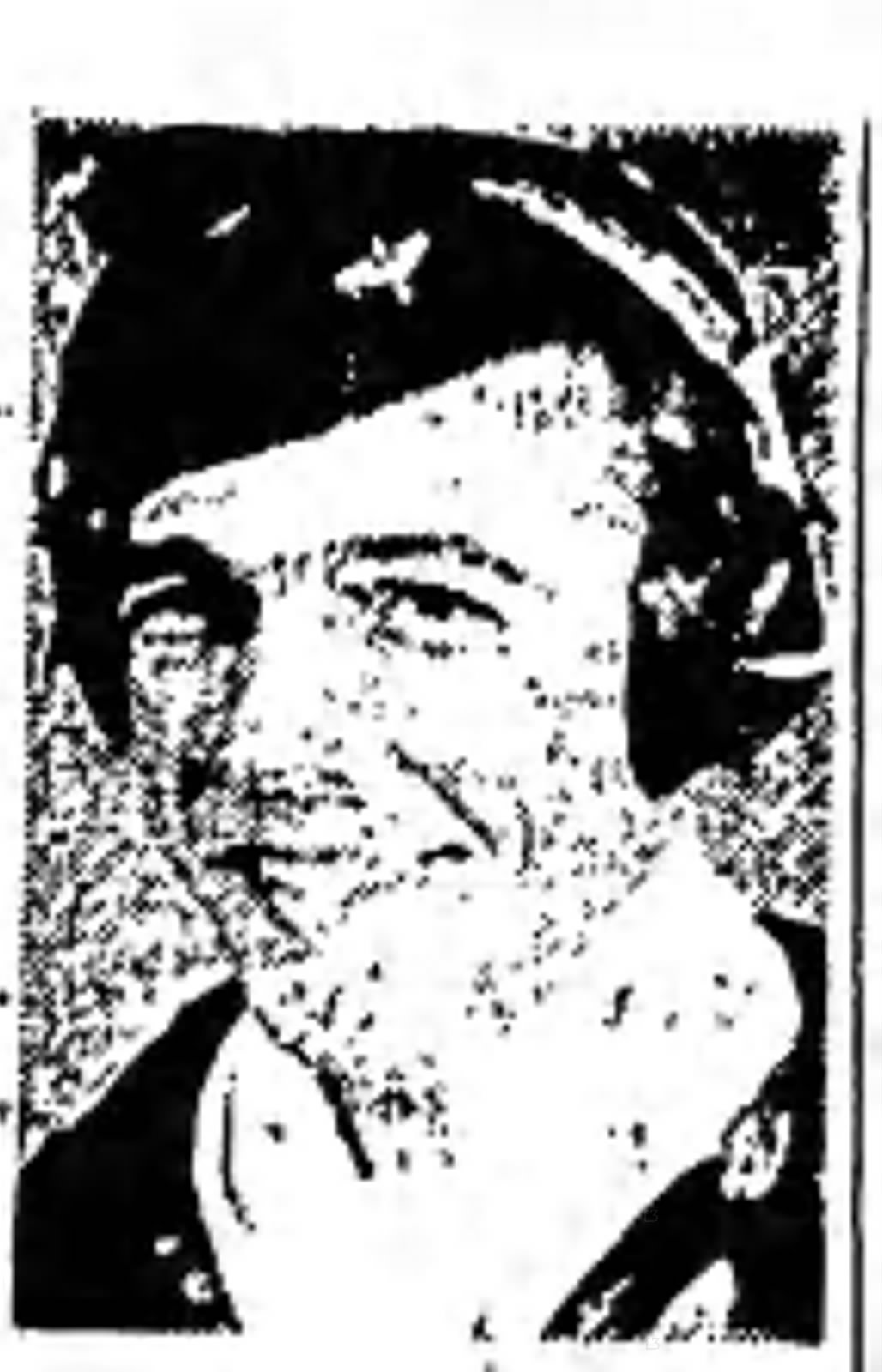
First Lieutenant (1LT) Axel Peter “Pete” Slustrop (Service No. O-738483) was born on 5 Feb 1922 in Portland, OR. His parents were Peter Slustrop and Karen Olsen Slustrop, both of whom were born in Denmark. Pete had a sister, Esther, and a half-sibling, Alfreida, from his mother’s first marriage. Pete attended Benson Polytechnic High School in Portland. When Pete enlisted in the US Army Air Forces (AAF) on 12 Mar 1942 at the Portland Army Airbase, he had completed one year of college and was working for the Austin Construction Co. On 3 Jun 1942, Pete was part of the group of AAF cadets to leave Portland for Santa Ana, CA, Replacement Center, for 7 ½ months of training before earning their wings. He completed basic training at Chico Army Airfield. which was under the command of the 10th Army Air Force Base Unit, AAF West Coast Training Center, Army Air Forces Training Command. Pete graduated from the AAF’s Advanced Flying School at Stockton Field in Stockton, CA, in February 1943 as a Second Lieutenant (2LT). 2LT Slustrop became a pilot in the 555th Bombardment Squadron, which was one of the four original Squadrons of the 386th Bombardment Group. The unit was constituted as the 386th Bombardment Group (Medium) on 25 Nov 1942 and was activated on 1 Dec 1942 at MacDill Field in Florida. The Squadron was first activated at MacDill Field in December 1942 as the 555th Bombardment Squadron. After training at MacDill Field and Lake Charles Army Air Field in Louisiana with the Martin B-26 Marauder, the Squadron departed for the European Theater of Operations in early May 1943. Upon arrival in England, the Squadron was stationed at RAF Snetterton Heath. However, Eighth Air Force had decided to transfer its B-26 units from VIII Bomber Command to VIII Air Support Command and move them to stations closer to the European continent. As a result, a week after its arrival, the Squadron moved to RAF Boxted. This move also put the Squadron's base in an area where it was planned to locate a future tactical air force. The Squadron's entry into combat was delayed by the fact that its training in the United States had concentrated on low level attacks, while Eighth Air Force had determined to use the Marauders in medium level attacks to avoid light flak. This required additional training. Although some diversionary missions were flown, the Squadron did not fly its first combat mission, an attack on Woensdrecht Airfield in the Netherlands, until 30 Jul 1943. During its first month of combat, the Squadron concentrated on attacks on enemy air bases, although it also attacked gun positions and marshalling yards. To improve accuracy, the Squadron participated in the 386th Group's first use of "drop on leader" tactics and revised formations in the European Theater in September 1943. The 9 Sep 1943 issue of Stars and Stripes published an article recounting how the crew of a B-26C Marauder, nicknamed Incendiary Mary, co-piloted by 2LT Slustrop, was able to evade every kind of flak on just one of its two engines, successfully complete its bombing missions over Rouen, France, and safely return to England, flying at only 7,000 feet, about half of its normal altitude and well within the range of German 7.99m flak. The pilot, Captain Don L Weiss, said that he had heard the Marauder could take evasive action on one engine, and that “I decided if it could be done, we could do it – so we did. All the way up past the coast and home.” The Squadron flew its last mission with Eighth Air Force on 8 Oct 1943 when it attacked an airfield near Lille. Shortly after its transfer to Ninth Air Force, the Squadron began participating in an extensive campaign against V-1 flying bomb and V-2 rocket sites in Operation Crossbow. During Big Week, the concentrated assault on Germany's aircraft manufacturing industry, including plants manufacturing aircraft instruments and depots for aviation supplies, the Squadron attacked airfields in Belgium and the Netherlands to weaken enemy air defenses against the heavy bombers striking the German aircraft industry in Operation Pointblank. 2LT Slustrop was promoted to 1LT in March 1944, by which time he had flown over 30 missions. In May 1944, 1LT Slustrop was awarded the Distinguished Flying Cross for having flown 25 missions over enemy-occupied Europe in a B-26C Marauder. At that time, he was quoted as saying, “Of the many missions, I remember especially a recent one to a vital Nazi installation in Northern France. It was quite rough, and our ship got back riddled with nearly a hundred flak holes. Two of the gas tanks were punctured and both prop governors were knocked off. And if that wasn’t enough, just after landing, the right engine conked out.” | |||||
|
In preparation for Operation Overlord, the invasion of the continent, the Squadron attacked airfields, marshalling yards and gun positions. In late May, just before the landings, it concentrated on bombing bridges across the Seine to interfere with possible enemy reinforcement of the landing areas. On D-Day, 6 Jun 1944, the Squadron hit coastal defenses, and during the fighting in Normandy, struck fuel and supply depots, lines of communication and enemy positions. The Squadron then continued to provide direct air support to advancing American and British forces attacking Caen. This was the mission 1LT Slustrop was participating in on 22 Jun 1944. He was the co-pilot in the crew of 8 when their B-26C Marauder was shot down by German anti-aircraft fire over the Cherbourg Peninsula in France, and the entire crew perished. 1LT Slustrop is listed on the Tablets of the Missing at the Normandy American Cemetery and Memorial, Colleville-sur-Mer, Departement du Calvados, Basse-Normandie, France. In May 1986, bone fragments and bits of ammunition were found in a pasture near Caen by a farmer plowing his field. US Army experts found pieces of leather flight jackets, shoes, the dial of an altimeter, and a ripped name tag. 1LT Slustrop’s remains were identified by the Hawaii Central Identification Laboratory. In November 1994, the Pentagon informed the families of the discovery and that these 8 men were no longer “missing”. On 4 Jan 1995 the remains of 1LT Slustrop, pilot Don Weiss, co-pilot Axel “Pete” Sustrop, and bombardier David Meserow were interred at Arlington National Cemetery in a single casket with the families of those men in attendance. The body of a 5th crew member was found shortly after the crash, but the bodies of the 3 other crew members were never found. Source : lwiesenfelder764 (Fold3) | ||||||









|
Crew of B-26 Marauder - type B-55-MA - s/n 42-96087 YA*O
| ||||||
|---|---|---|---|---|---|---|
| Lt-Col | Don L | WEISS | Pilot | Dead | Arlington Nat Cem | O-437629 - DFC/AM+10/PH - 28 ans |
| 1Lt | Axel Peter SLUSTROP | CoPilot | Dead | Arlington Nat Cem. | O-738483 - DFC/AM+9/PH - Né en 1922 - Multnomah, Oregon | |
| 1Lt | David | MESEROW | Bomber | Dead | Arlington Nat Cem. | O-732880 - DFC/AM+10/PH |
| 1Lt | George H | HAZLETT | Navigator | Dead | Arlington Nat Cem. | O-794005 - DFC/AM+11/PH - Né en 1920 - Middlesex, Massachusetts |
| T/Sgt | Robert E | PERKINS | Gunner | Dead | MIA - Tablets Cim Am Colleville-sur-Mer | 33297432 - AM+8/PH - Né en 1922 - Crawford, Pennsylvania |
| S/Sgt | John H | CANTY | Gunner | Dead | Cim Am Colleville-sur-Mer | 11072858 - DFC/AM/PH - Connecticut - Ossements retrouvés en 2014 près d'Evrecy (14) |
| S/Sgt | Thomas | McCASLIN | Gunner | Dead | MIA - Tablets Cim Am Colleville-sur-Mer | 17038437 - DFC/AM+11/PH - Né en 1918 - Fils de George McCaslin - Nebraska |
| Capt | Orville Donald "Don" | THATCHER | Passager | Dead | North Lawn Cem. Fort Dodge, Iowa | O-356255 - 31 ans Luther, Boone Co, Iowa - Médecin - Fils de Orville Milton et Lillie (Eckersley) Thatcher |
 |
||||||
| SOURCE INFORMATION & SOURCE PHOTO | Arnaud Gaté - Findagrave.com - Abmc.gov - Findagrave.com |
|---|---|
| REDACTEURS | Victor, Jean-Philippe, Eric, Henri, Garrett, Clive, Frédéric & Renaud |