


|
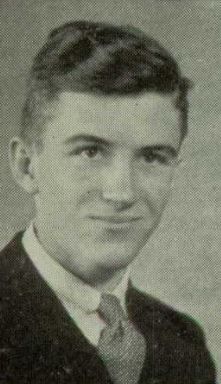
Richard Kent SHACKELFORD
| ||||||||||||||||||||||||||||||
|---|---|---|---|---|---|---|---|---|---|---|---|---|---|---|---|---|---|---|---|---|---|---|---|---|---|---|---|---|---|---|
|
1934 HS photo from Richard's yearbook Source : Arnaud Gaté & Erica Swenson Elliott | ||||||||||||||||||||||||||||||
| NUMBER OF SERVICE | O-1010269 | |||||||||||||||||||||||||||||
| AGE | 27 yo | |||||||||||||||||||||||||||||
| DATE OF BIRTH |
24 July 1916 NEW ZEALAND | |||||||||||||||||||||||||||||
| ENLISTMENT STATE | MARYLAND | |||||||||||||||||||||||||||||
| FAMILY |
Spouse : Barbara Booth Parents : Ezekiel Joel & Elsie Kent Shackelford | |||||||||||||||||||||||||||||
| RANK |
| |||||||||||||||||||||||||||||
| FONCTION | ||||||||||||||||||||||||||||||
| JOB BEFORE ENLISTEMENT |  | |||||||||||||||||||||||||||||
| DATE of ENLISTEMENT | ||||||||||||||||||||||||||||||
| COMPANY | ||||||||||||||||||||||||||||||
| BATTALION | ||||||||||||||||||||||||||||||
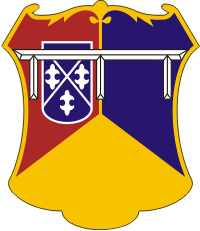
| REGIMENT | 66th Regiment | |||||||||||||||||||||||||||||
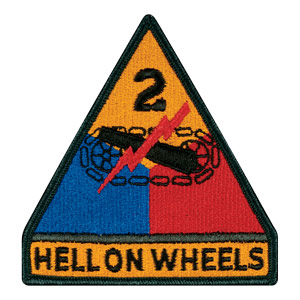
| DIVISION | 2nd Armored Division | |||||||||||||||||||||||||||||
| DATE OF DEATH | 15 June 1944 |
Source : Erica Swenson Elliott | ||||||||||||||||||||||||||||
| STATUS | KIA | |||||||||||||||||||||||||||||
| PLACE OF DEATH | Route Carentan-Hauverville | |||||||||||||||||||||||||||||
| CEMETERY TEMPORARY |
CEMETERY TEMPORARY of -- N°-- | |||||||||||||||||||||||||||||
| CEMETERY | NORMANDY AMERICAN CEMETERY of Colleville | |||||||||||||||||||||||||||||
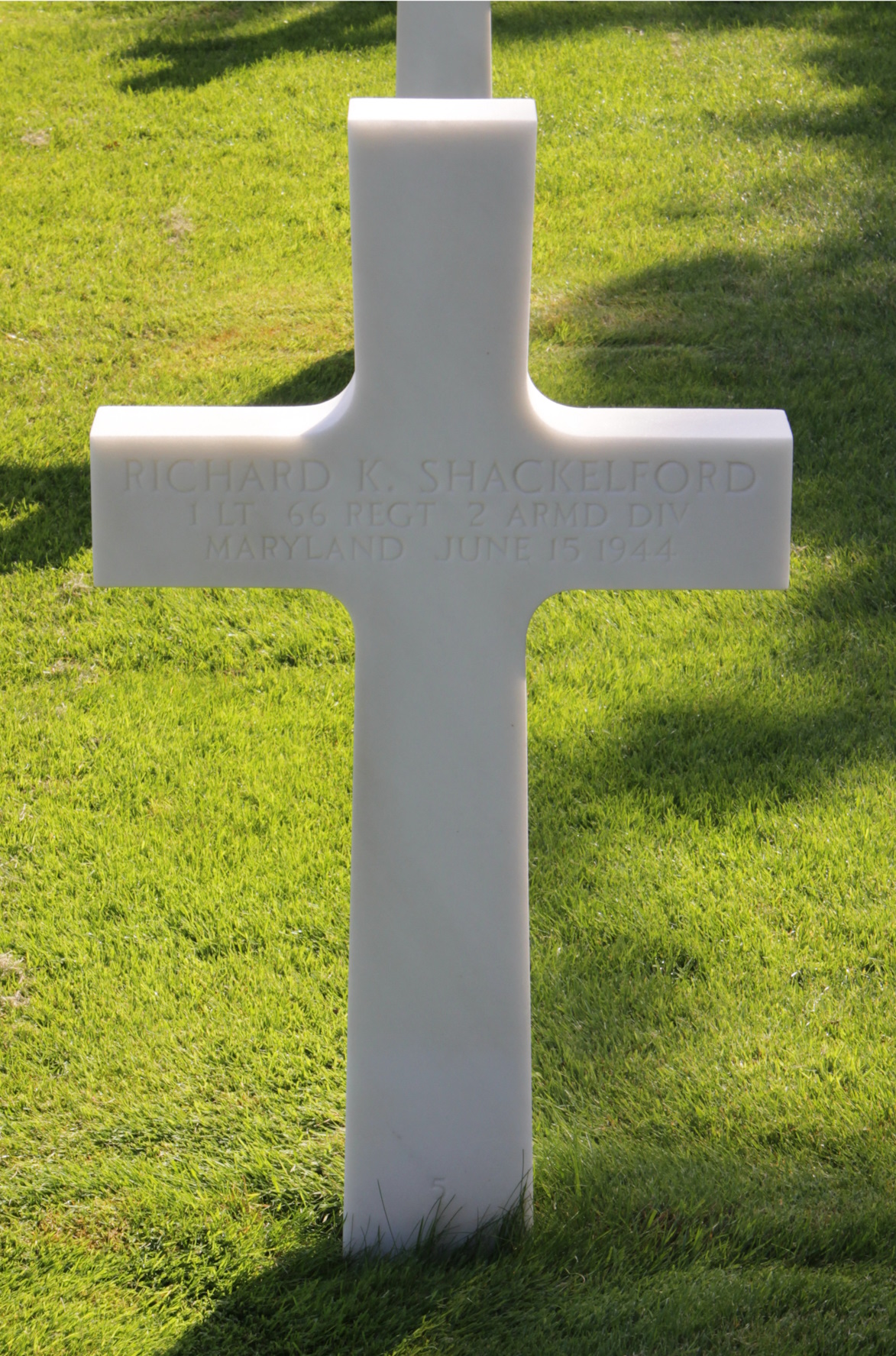
| GRAVE |
| |||||||||||||||||||||||||||||
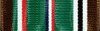
| DECORATION |
| |||||||||||||||||||||||||||||
| ||||||||||||||||||||||||||||||
| STORY | ||||||||||||||||||||||||||||||
|
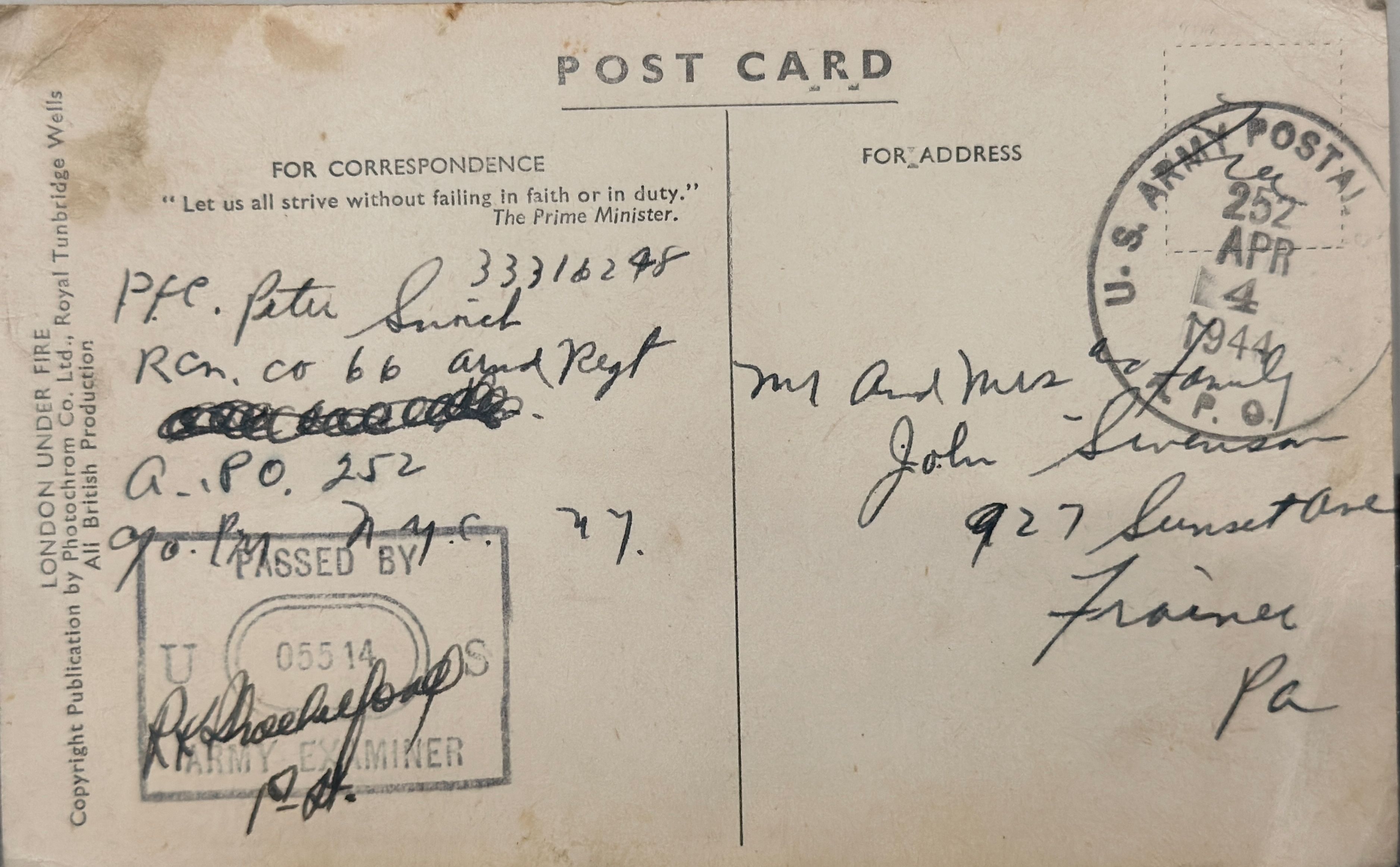
1st Lt Shackelford's name does not appear on the Landing Ship Transport (LST)'s manifest when the Reconnaissance Company left North Africa for its amphibious landing and assault on Sicily in July of 1943. It is not yet discovered exactly when Richard joined the Reconnaissance Company. However by April 4, 1944, he was found censoring the mail of Reconnaissance while they were stationed in Tidworth, England. See attached Pete Snoich's postcard to this memorial. Richard's signature is in the bottom left corner. On June 9, 1944, D-Day+3, the 2nd Armored Division "Hell On Wheels" began landing on Omaha Beach in the vicinity of St.Laurent-Sur-Mer, France. This Is according to LTC R. W. Jenna's 2 page G-3 Report summary for the movements of the entire Division for the month of June 1944. The report records that it takes close to a week to fully unload the heavy weapons of war and the 10,000 men in the 2nd Armored Division and fully prepare for combat. However, while the unloading continued, the next day on the 10th,patrols from the Reconnaissance Company were sent south in the vicinity of Mosles to contact friendly troops. Shackelford may have been one of them. The most common vehicle used by the Reconnaissance crews was the M4 Greyhound armored car. It was equipped with two guns, lighter armor, so it was faster but more vulnerable to landmines and tanks if successfully targeted. | ||||||||||||||||||||||||||||||
|
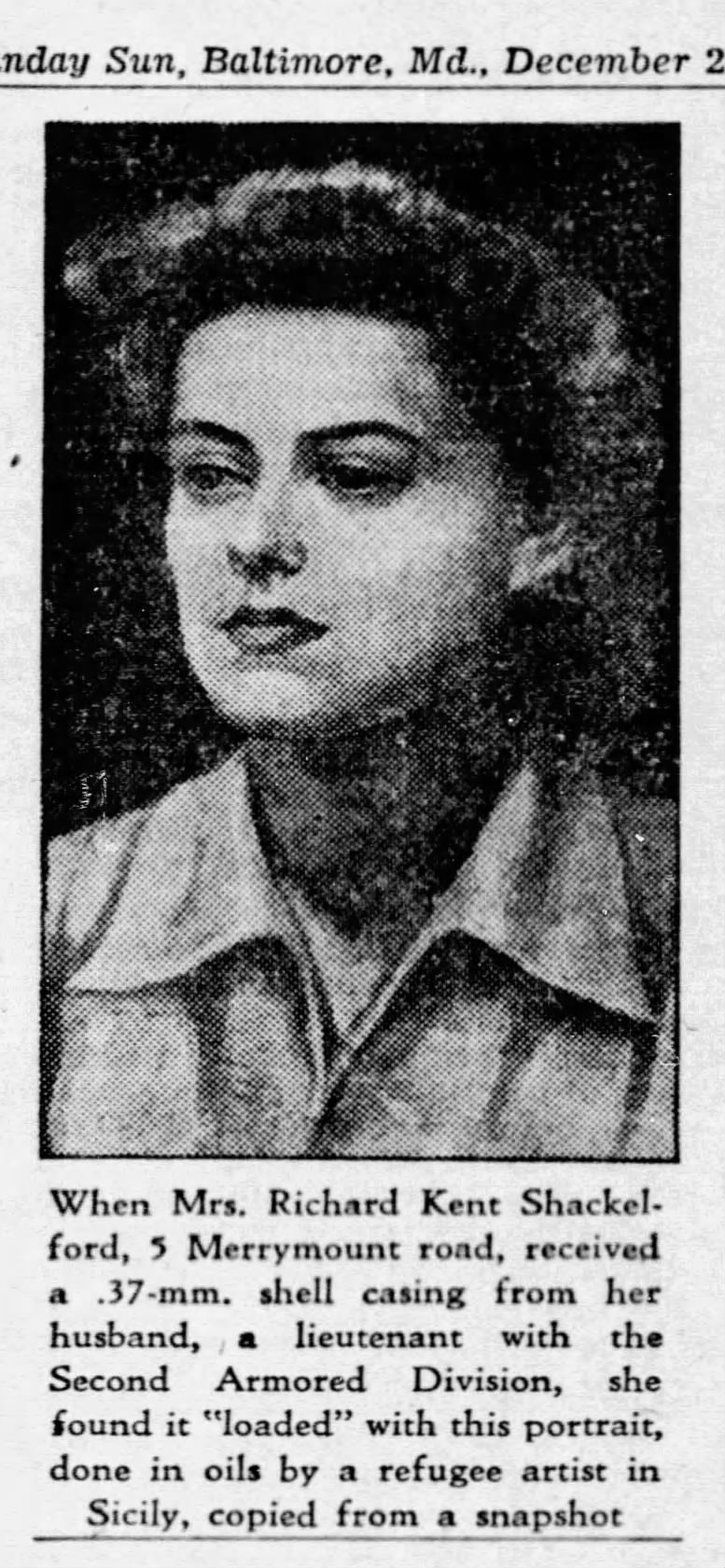
1943DEC26, Baltimore Sun: oil portrait of RK's wife he sent home in a 37mm shell casing. by Sicilian refugee Source : Erica Swenson Elliott |
Then on June 13th, 2 days before Richard's death, the mission was changed to execute two coordinated attacks with the 101st Airborne Division in the vicinity of Carentan, France. During this battle, the 1st Battalion of the 66th Armored Regiment is commanded by LTC Parker, he has two Companies of tanks assigned to him. I Company of Sherman medium tanks and C Company of Stuart light tanks. They launched their attack about 430-530 in the afternoon and seized their objective by 9 in the evening. During this battle, the tankers moved Southwest along the Carentan-Hauverville road. They shadowed the pace of the accompanying foot soldiers. During this battle, Lt. Lamar Russell is a light tank platoon leader in C Company, which means five Stuart tanks are under his command. Sometime during this fight, Lt. Russell witnesses the death of Shackelford in the destruction of two reconnaissance vehicles and their crews, just 100 yards to Russell's front. This firsthand account can be found on page 223 of Gordon A. Blaker's account, "Iron Knights: The US 66th Armored Regiment in WWII." In Private Don Evans book, The Odyssey of an Iron Knight '' we find more harrowing details about this battle when Shackelford was killed. Serving in the same Reconnaissance Company, Evans writes on page 46: "As we left the battlefield that evening of June 15, 1944, in that very small portion of Normandy, we left behind the hulks of wrecked and burning vehicles. It was a macabre sight with so many dead on both sides lying about, seemingly to spoil this once serene pasture. Shells had plowed up turf, and the trees and bushes whose foliage had been shredded by machine gun fire now could not conceal the lifeless bodies of enemy soldiers." By : Erica Swenson Elliott | |||||||||||||||||||||||||||||
|
My GUncle's postcard passed his censorship on April 4, 1944 two months before Richardwas killed. Lower left". RK. Shackelford 1st LT" they served in the same Recon Co. Source : Erica Swenson Elliott | ||||||||||||||||||||||||||||||







Activated/Activé |
Normandy/Normandie |
| 15 Jul 1940 | Days of Combat/Jour de Combat 443 |
| Casualties/Victimes 20 659 | |
Entered Combat/Entré au combat |
|
| 8 Nov 1942 | |
|
Commanding Generals/Commandants généraux Maj. Gen. Charles L. Scott (Jul 40 - Jan 41) |
Campaigns/CampagnesAlgeria-French Morocco (8 Nov 42 - 11 Nov 42) |
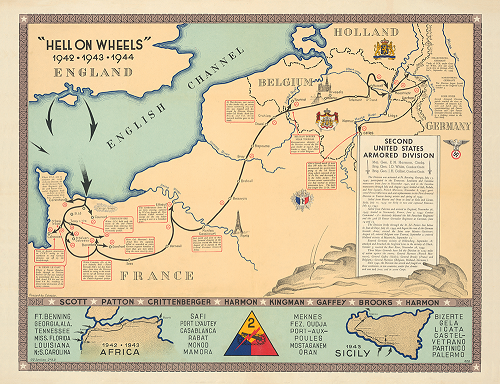
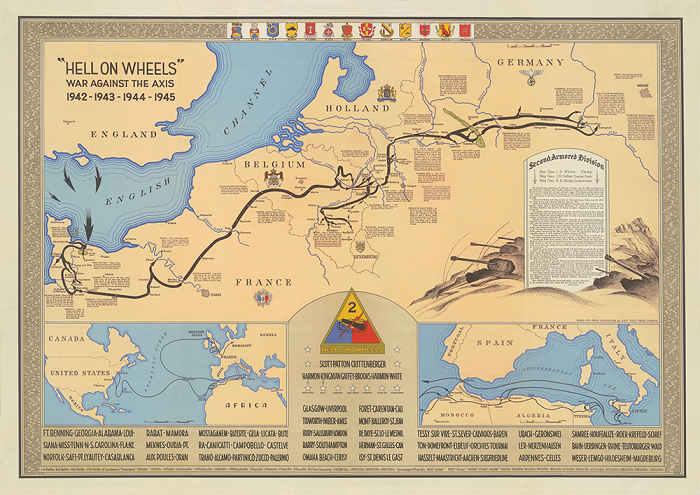
CARTES DE CAMPAGNE DE LA 2e DIVISION BLINDÉE - CAMPAIGN MAPS OF THE 2nd ARMORED DIVISION |
|
 |
|
|
These vintage maps chart the journey of the 2nd Armored Division throughout Europe during World War II. The top map covers the years 1942 to 1944. The bottom map includes 1945. Ces cartes d'époque illustrent le parcours de la 2e division blindée à travers l'Europe pendant la Seconde Guerre mondiale. La carte du haut couvre les années 1942 à 1944. La carte du bas comprend 1945.
|
|
 |
|
DIVISION CHRONICLEElements of the Division first saw action in North Africa, landing at Casablanca, 8 November 1942, and later taking part in the fighting at Beja, Tunisia, but the Division as a whole did not enter combat until the invasion of Sicily, when it made an assault landing at Gela, 10 July 1943. The Division saw action at Butera, Campobello,-and Palermo. After the Sicilian campaign, the Division trained in England for the cross-Channel invasion, landed in Normandy D plus 3, 9 June 1944, and went into action in the vicinity of Carentan; ; the Division raced across France in July and August, drove through Belgium and attacked across the Albert Canal 13 September 1944, crossing the German border at Schimmert, 18 September to take up defensive positions near Geilenkirchen. On 3 October, the Division launched an attack on the Siegfried Line from Marienberg, broke through, crossed the Wurm River and seized Puffendorf 16 November and Barmen 28 November. The Division was holding positions on the Roer when it was ordered to help contain the German Ardennes offensive. The Division fought in eastern Belgium, blunting the German Fifth Panzer Army's penetration of American lines. The Division helped reduce the Bulge in January, fighting in the Ardennes forest in deep snow, and cleared the area from Houffalize to the Ourthe River of the enemy. After a rest in February, the Division drove on across the Rhine 27 March, and was the first American Division to reach the Elbe at Schonebeck on 11 April. It was halted on the Elbe, 20 April, on orders. In July the Division entered Berlin-the first American unit to enter the German capital city. |
CHRONIQUE DE DIVISIONDes éléments de la division ont d'abord été déployés en Afrique du Nord, atterrissant à Casablanca le 8 novembre 1942, puis ont pris part aux combats à Beja, en Tunisie, mais la division dans son ensemble n'a pas envahi la Sicile. un assaut atterrissant à Gela, le 10 juillet 1943. La division a été attaquée à Butera, Campobello et Palerme. Après la campagne sicilienne, la division s’est entraînée en Angleterre pour l’invasion transmanche, a atterri en Normandie D plus 3, le 9 juin 1944, et s’est engagée dans les environs de Carentan; ; La Division a traversé la France en juillet et août, a traversé la Belgique le 13 septembre 1944 et a franchi la frontière allemande à Schimmert le 18 septembre pour traverser le canal Albert afin de prendre des positions défensives près de Geilenkirchen. Le 3 octobre, la division a lancé une attaque sur la ligne Siegfried au départ de Marienberg, a franchi la rivière Wurm et a saisi Puffendorf le 16 novembre et Barmen le 28 novembre. La division tenait des positions sur le Roer quand il a été ordonné d'aider à contenir l'offensive des Ardennes allemandes. La division a combattu dans l'est de la Belgique, brisant la pénétration des lignes américaines par la cinquième armée panzer allemande. La division a aidé à réduire les Ardennes en janvier, se battant dans la forêt des Ardennes dans la neige profonde, et a dégagé la zone de Houffalize à la rivière Ourthe de l'ennemi. Après un repos en février, la division a traversé le Rhin le 27 mars et a été la première division américaine à atteindre l’Elbe à Schonebeck le 11 avril. Il a été arrêté sur l'Elbe, le 20 avril, sur ordre. En juillet, la division est entrée dans Berlin, la première unité américaine à entrer dans la capitale allemande. |
| SOURCE INFORMATION & PHOTO | Armydivs.squarespace.com |
|---|
| SOURCE INFORMATION & SOURCE PHOTO | Arnaud Gaté - Erica Swenson Elliott - Findagrave.com - Abmc.gov |
|---|---|
| EDITORS | Victor, Jean-Philippe, Eric, Henri, Garrett, Clive, Frédéric & Renaud |